Aristotle
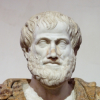
Aristotle
Aristotle was a Greek philosopher and scientist born in the city of Stagira, Chalkidice, on the northern periphery of Classical Greece. His father, Nicomachus, died when Aristotle was a child, whereafter Proxenus of Atarneus became his guardian. At eighteen, he joined Plato's Academy in Athens and remained there until the age of thirty-seven. His writings cover many subjects – including physics, biology, zoology, metaphysics, logic, ethics, aesthetics, poetry, theater, music, rhetoric, linguistics, politics and government – and constitute the first comprehensive system...
NationalityGreek
ProfessionPhilosopher
There is simple ignorance, which is the source of lighter offenses, and double ignorance, which is accompanied by a conceit of wisdom.
For good is simple, evil manifold.
Error is multiform (for evil is a form of the unlimited, as in the old Pythagorean imagery, and good of the limited), whereas success is possible in one way only (which is why it is easy to fail and difficult to succeed - easy to miss the target and difficult to hit it); so this is another reason why excess and deficiency are a mark of vice, and observance of the mean a mark of virtue: Goodness is simple, badness is manifold.
...perhaps there is some element of good even in the simple act of living, so long as the evils of existence do not preponderate too heavily.
Virtue means doing the right thing, in relation to the right person, at the right time, to the right extent, in the right manner, and for the right purpose. Thus, to give money away is quite a simple task, but for the act to be virtuous, the donor must give to the right person, for the right purpose, in the right amount, in the right manner, and at the right time.
To the query, ''What is a friend?'' his reply was ''A single soul dwelling in two bodies.''
A true friend is one soul in two bodies.
A tragedy is the imitation of an action that is serious, and also, as having magnitude, complete in itself . . . with incidents arousing pity and terror, with which to accomplish its purgation of these emotions.
Man is the only animal capable of reasoning, though many others possess the faculty of memory and instruction in common with him.
Piety requires us to honor truth above our friends.
The eyes of some persons are large, others small, and others of a moderate size; the last-mentioned are the best. And some eyes are projecting, some deep-set, and some moderate, and those which are deep-set have the most acute vision in all animals; the middle position is a sign of the best disposition.
Some animals utter a loud cry. Some are silent, and others have a voice, which in some cases may be expressed by a word; in others, it cannot. There are also noisy animals and silent animals, musical and unmusical kinds, but they are mostly noisy about the breeding season.
The poet, being an imitator like a painter or any other artist, must of necessity imitate one of three objects - things as they were or are, things as they are said or thought to be, or things as they ought to be. The vehicle of expression is language - either current terms or, it may be, rare words or metaphors.
There was never a genius without a tincture of madness.