Aristotle
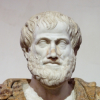
Aristotle
Aristotle was a Greek philosopher and scientist born in the city of Stagira, Chalkidice, on the northern periphery of Classical Greece. His father, Nicomachus, died when Aristotle was a child, whereafter Proxenus of Atarneus became his guardian. At eighteen, he joined Plato's Academy in Athens and remained there until the age of thirty-seven. His writings cover many subjects – including physics, biology, zoology, metaphysics, logic, ethics, aesthetics, poetry, theater, music, rhetoric, linguistics, politics and government – and constitute the first comprehensive system...
NationalityGreek
ProfessionPhilosopher
Man is the only animal capable of reasoning, though many others possess the faculty of memory and instruction in common with him.
That which is common to the greatest number has the least care bestowed upon it
It is clear that those constitutions which aim at the common good are right, as being in accord with absolute justice; while those which aim only at the good of the rulers are wrong.
Metaphor is halfway between the unintelligible and the commonplace.
Of the irrational part of the soul again one division appears to be common to all living things, and of a vegetative nature.
One citizen differs from another, but the salvation of the community is the common business of them all. This community is the constitution; the virtue of the citizen must therefore be relative to the constitution of which he is a member.
The trade of the petty usurer is hated with most reason: it makes a profit from currency itself, instead of making it from the process which currency was meant to serve. Their common characteristic is obviously their sordid avarice.
A common danger unites even the bitterest enemies.
To write well, express yourself like common people, but think like a wise man. Or, think as wise men do, but speak as the common people do.
To the query, ''What is a friend?'' his reply was ''A single soul dwelling in two bodies.''
A true friend is one soul in two bodies.
A tragedy is the imitation of an action that is serious, and also, as having magnitude, complete in itself . . . with incidents arousing pity and terror, with which to accomplish its purgation of these emotions.
Piety requires us to honor truth above our friends.
The eyes of some persons are large, others small, and others of a moderate size; the last-mentioned are the best. And some eyes are projecting, some deep-set, and some moderate, and those which are deep-set have the most acute vision in all animals; the middle position is a sign of the best disposition.