Aristotle
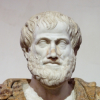
Aristotle
Aristotle was a Greek philosopher and scientist born in the city of Stagira, Chalkidice, on the northern periphery of Classical Greece. His father, Nicomachus, died when Aristotle was a child, whereafter Proxenus of Atarneus became his guardian. At eighteen, he joined Plato's Academy in Athens and remained there until the age of thirty-seven. His writings cover many subjects – including physics, biology, zoology, metaphysics, logic, ethics, aesthetics, poetry, theater, music, rhetoric, linguistics, politics and government – and constitute the first comprehensive system...
NationalityGreek
ProfessionPhilosopher
Learning is an ornament in prosperity, a refuge in adversity, and a provision in old age.
Education begins at the level of the learner.
To appreciate the beauty of a snow flake, it is necessary to stand out in the cold.
Whereas young people become accomplished in geometry and mathematics, and wise within these limits, prudent young people do not seem to be found. The reason is that prudence is concerned with particulars as well as universals, and particulars become known from experience, but a young person lacks experience, since some length of time is needed to produce it.
All learning is derived from things previously known.
A young man is not a proper hearer of lectures on political science; for he is inexperienced in the actions that occur in life, but its discussions start from these and are about these; and, further, since he tends to follow his passions, his study will be vain and unprofitable, because the end that is aimed at is not knowledge but action. And it makes no difference whether he is young in years or youthful in character.
Learning is not child's play; we cannot learn without pain.
What we have to learn to do, we learn by doing.
To the query, ''What is a friend?'' his reply was ''A single soul dwelling in two bodies.''
A true friend is one soul in two bodies.
A tragedy is the imitation of an action that is serious, and also, as having magnitude, complete in itself . . . with incidents arousing pity and terror, with which to accomplish its purgation of these emotions.
Man is the only animal capable of reasoning, though many others possess the faculty of memory and instruction in common with him.
Piety requires us to honor truth above our friends.
The eyes of some persons are large, others small, and others of a moderate size; the last-mentioned are the best. And some eyes are projecting, some deep-set, and some moderate, and those which are deep-set have the most acute vision in all animals; the middle position is a sign of the best disposition.