Aristotle
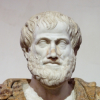
Aristotle
Aristotle was a Greek philosopher and scientist born in the city of Stagira, Chalkidice, on the northern periphery of Classical Greece. His father, Nicomachus, died when Aristotle was a child, whereafter Proxenus of Atarneus became his guardian. At eighteen, he joined Plato's Academy in Athens and remained there until the age of thirty-seven. His writings cover many subjects – including physics, biology, zoology, metaphysics, logic, ethics, aesthetics, poetry, theater, music, rhetoric, linguistics, politics and government – and constitute the first comprehensive system...
NationalityGreek
ProfessionPhilosopher
Everybody loves a thing more if it has cost him trouble: for instance those who have made money love money more than those who have inherited it.
Men cling to life even at the cost of enduring great misfortune.
The self-indulgent man craves for all pleasant things... and is led by his appetite to choose these at the cost of everything else.
To the query, ''What is a friend?'' his reply was ''A single soul dwelling in two bodies.''
A true friend is one soul in two bodies.
A tragedy is the imitation of an action that is serious, and also, as having magnitude, complete in itself . . . with incidents arousing pity and terror, with which to accomplish its purgation of these emotions.
Man is the only animal capable of reasoning, though many others possess the faculty of memory and instruction in common with him.
Piety requires us to honor truth above our friends.
The eyes of some persons are large, others small, and others of a moderate size; the last-mentioned are the best. And some eyes are projecting, some deep-set, and some moderate, and those which are deep-set have the most acute vision in all animals; the middle position is a sign of the best disposition.
Some animals utter a loud cry. Some are silent, and others have a voice, which in some cases may be expressed by a word; in others, it cannot. There are also noisy animals and silent animals, musical and unmusical kinds, but they are mostly noisy about the breeding season.
The poet, being an imitator like a painter or any other artist, must of necessity imitate one of three objects - things as they were or are, things as they are said or thought to be, or things as they ought to be. The vehicle of expression is language - either current terms or, it may be, rare words or metaphors.
There was never a genius without a tincture of madness.
Some animals are cunning and evil-disposed, as the fox; others, as the dog, are fierce, friendly, and fawning. Some are gentle and easily tamed, as the elephant; some are susceptible of shame, and watchful, as the goose. Some are jealous and fond of ornament, as the peacock.
Persuasion is clearly a sort of demonstration, since we are most fully persuaded when we consider a thing to have been demonstrated.