Apollonius of Tyana
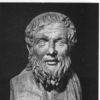
Apollonius of Tyana
Apollonius of Tyana, sometimes also called Apollonios of Tyana, was a Greek Neopythagorean philosopher from the town of Tyana in the Roman province of Cappadocia in Anatolia. Being a 1st-century orator and philosopher around the time of Jesus, he was compared with Jesus of Nazareth by Christians in the 4th century and by other writers in modern times...
NationalityGreek
ProfessionPhilosopher
birth appearance seeming
There is no death of anyone, save in appearance, just as there is no birth of any, save only in seeming.
both imperial understood
Nero may have understood how to tune his cithern, but he disgraced his imperial office both by slackening and by tightening the strings.
contains equivalent stones subject theaters unless useless wisdom
Multicolored stones and paintings, walkways, and theaters are useless in a city unless it also contains wisdom and law. Such things are the subject of wisdom and law, not equivalent to them.
believe despot itself man popular prone scandal
Never may a man prone to believe scandal be a despot or a popular leader! Under his guidance, democracy itself will be despotism.
prayer men giving
The only prayer which a well-meaning man can pray is, O ye gods, give me whatever is fitting unto me!
cities race earth
In India, I found a race of mortals living upon the Earth, but not adhering to it, inhabiting cities, but not being fixed to them, possessing everything, but possessed by nothing
art healing long
Pythagoras said that the most divine art was that of healing. And if the healing art is most divine, it must occupy itself with the soul as well as with the body; for no creature can be sound so long as the higher part in it is sickly.
creates masters money plato principle rejoice
Plato said that virtue has no master. If a person does not honor this principle and rejoice in it, but is purchasable for money, he creates many masters for himself.
man perceive
It is a true man's part not to err, but it is also noble of a man to perceive his error.
commune time
It is at the time of dawn that we must commune with the gods.
best common individual monarchy rule transforms worth
Just as an individual of pre-eminent worth transforms democracy into a monarchy of the best man, even so the rule of one man, if in all things it has an eye to the common welfare, is democracy.
My ideal is for each to do what he knows and what he can.
O ye gods, grant unto me to have little and to want nothing.
bad earth far good hear men nor pleasure send thou
O thou Sun, send me as far over the earth as is my pleasure and thine, and may I make the acquaintance of good men, but never hear anything of bad ones, nor they of me.