Alexander Hamilton
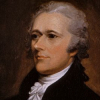
Alexander Hamilton
Alexander Hamiltonwas a Founding Father of the United States, chief staff aide to General George Washington, one of the most influential interpreters and promoters of the U.S. Constitution, the founder of the nation's financial system, the founder of the Federalist Party, the world's first voter-based political party, the founder of the United States Coast Guard, and the founder of The New York Post newspaper. As the first Secretary of the Treasury, Hamilton was the primary author of the economic policies...
NationalityAmerican
ProfessionPolitician
Date of Birth11 January 1757
CountryUnited States of America
The militia is a voluntary force not associated or under the control of the States except when called out; [ when called into actual service] a permanent or long standing force would be entirely different in make-up and call.
There is nothing absurd or impracticable in the idea of a league or alliance between independent nations for certain defined purposes precisely stated in a treaty regulating all the details of time, place, circumstance, and quantity; leaving nothing to future discretion; and depending for its execution on the good faith of the parties.
The rights of neutrality will only be respected when they are defended by an adequate power. A nation, despicable by its weakness, forfeits even the privilege of being neutral.
There is no part of the administration of government that requires extensive information and a thorough knowledge of the principles of political economy, so much as the business of taxation. The man who understands those principles best will be least likely to resort to oppressive expedients, or sacrifice any particular class of citizens to the procurement of revenue. It might be demonstrated that the most productive system of finance will always be the least burdensome.
It is evident from the state of the country, from the habits of the people, from the experience we have had on the point itself, that it is impracticable to raise any very considerable sums by direct taxation.
The awful discretion, which a court of impeachments must necessarily have, to doom to honor or to infamy the most confidential and the most distinguished characters of the community, forbids the commitment of the trust to a small number of persons.
What bitter anguish would not the people of Athens have often escaped if their government had contained so provident a safeguard against tyranny of their own passions? Popular liberty might then have escaped the indelible reproach of decreeing to the same citizens the hemlock on one day and statutes the next.
A republic of this kind, able to withstand an external force, may support itself without any internal corruptions. The form of this society prevents all manner of inconveniences.
[A] power equal to every possible contingency must exist somewhere in the government . . .
A government, the constitution of which renders it unfit to be trusted with all the powers which a free people ought to delegate to any government, would be an unsafe and improper depositary of the NATIONAL INTERESTS.
Of all the cares or concerns of government, the direction of war most peculiarly demands those qualities which distinguish the exercise of power by a single hand. The direction of war implies the direction of the common strength; and the power of directing and employing the common strength, forms a usual and essential part in the definition of the executive authority.
These powers ought to exist without limitation, because it is impossible to foresee or to define the extent and variety of national exigencies, and the correspondent extent and variety of the means which may be necessary to satisfy them.
This power ought to be coextensive with all the possible combinations of such circumstances; and ought to be under the direction of the same councils which are appointed to preside over the common defense.
Perhaps myself the first, at some expense of popularity, to unfold the true character of Jefferson, it is too late for me to become his apologist. Nor can I have any disposition to do it. I admit that his politics are tinctured with fanaticism, that he is too much in earnest in his democracy, that he has been a mischievous enemy to the principle measures of our past administration, that he is crafty & persevering in his objects, that he is not scrupulous about the means of success, nor very mindful of truth, and that he is a contemptible hypocrite.