Aleksandr Solzhenitsyn
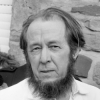
Aleksandr Solzhenitsyn
Aleksandr Isayevich Solzhenitsyn was a Russian novelist, historian, and short story writer. He was an outspoken critic of the Soviet Union and its totalitarianism and helped to raise global awareness of its Gulag forced labor camp system. He was allowed to publish only one work in the Soviet Union, One Day in the Life of Ivan Denisovich, in the periodical Novy Mir. After this he had to publish in the West, most notably Cancer Ward, August 1914, and The Gulag...
NationalityRussian
ProfessionNovelist
Date of Birth11 December 1918
CityKislovodsk, Russia
CountryRussian Federation
Lord, give me the strength to accomplish what You've given me to do and the faith to trust You that what I haven't been able to accomplish You've already assigned to someone else.
To preserve his life, should a man pay everything that gives it color, scent and excitement?
Ideology - that is what gives evildoing its long-sought justification and gives the evildoer the neccessary steadfastness and determination... Thanks to ideology, the twentieth century was fated to experience evildoing on a scale calculated in the millions.
You took my freedom away a long time ago and you can't give it back because you haven't got it yourself.
It's true that private enterprise is extremely flexible, But its only good within very narrow limits. If private enterprise isn't held in an iron grip it gives birth to people who are no better than beasts, those stock-exchange people with greedy appetites beyond restraint.
We are all human, and our senses are quicker to prompt us than our reason. Every man gives off a scent, and that scent tells you how to act before your head does.
I have not painted the dark reality in rose-tinted shades but I do include a clear way, a search for something brighter, some way out - most importantly in the spiritual sense.
The demands of internal growth are incomparably more important to us... than the need for any external expansion of our power.
When I was young, the early death of my father cast a shadow over me - and I was afraid to die before all my literary plans came true. But between 30 and 40 years of age my attitude to death became quite calm and balanced. I feel it is a natural, but no means the final, milestone of one's existence.
Communist propaganda would sometimes include statements such as "we include almost all the commandments of the Gospel in our ideology". The difference is that the Gospel asks all this to be achieved through love, through self-limitation, but socialism only uses coercion. This is one point.
For me faith is the foundation and support of one's life.
Religion itself cannot but be dynamic. In order to combat modern materialistic mores, to fight nihilism and egotism, religion must also develop, must be flexible in its forms, and it must have a correlation with the cultural forms of the epoch.
The term "national idea" is an unclear one. One might think of it as a widely shared understanding among a people as to the desired way of life in their country, an idea that holds sway over the population. A unifying concept like that can be useful, but should never be created artificially or imposed top-down by the powers-that-be.
One should not ascribe the evil deeds of individual leaders or political regimes to an innate fault of the Russian people and their country.