Aldo Leopold
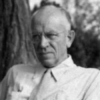
Aldo Leopold
Aldo Leopoldwas an American author, scientist, ecologist, forester, conservationist, and environmentalist. He was a professor at the University of Wisconsin and is best known for his book A Sand County Almanac, which has sold more than two million copies...
NationalityAmerican
ProfessionActivist
Date of Birth11 January 1887
CityBurlington, IA
CountryUnited States of America
land no-fear pleasant
Once you learn to read the land, I have no fear of what you will do to it, or with it. And I know many pleasant things it will do to you.
mean eye hunting
We reached the old wolf in time to watch a fierce green fire dying in her eyes. I realized then, and have known ever since, that there was something new to me in those eyes – something known only to her and to the mountain. I was young then, and full of trigger-itch; I thought that because fewer wolves meant more deer, that no wolves would mean hunters’ paradise. But after seeing the green fire die, I sensed that neither the wolf nor the mountain agreed with such a view.
land creating tree
When some remote ancestor of ours invented the shovel, he became a giver: He could plant a tree. And when the axe was invented, he became a taker: He could chop it down. Whoever owns land has thus assumed, whether he knows it or not, the divine functions of creating and destroying plants.
doubt pavement soil
There can be no doubt that a society rooted in the soil is more stable than one rooted in pavements.
children growing-up mind
When I call to mind my earliest impressions, I wonder whether the process ordinarily referred to as growing up is not actually a process of growing down; whether experience, so much touted among adults as the thing children lack, is not actually a progressive dilution of the essentials by the trivialities of living.
hunting hunters peculiar
A peculiar virtue in wildlife ethics is that the hunter ordinarily has no gallery to applaud or disapprove of his conduct
priorities challenges might
For unnumbered centuries of human history the wilderness has given way. The priority of industry has become dogma. Are we as yet sufficiently enlightened to realize that we must now challenge that dogma, or do without our wilderness? Do we realize that industry, which has been our good servant, might make a poor master?
spiritual two supposing-that
There are two spiritual dangers in not owning a farm. One is the danger of supposing that breakfast comes from the grocery, and the other that heat comes from the furnace.
spring solitude degrees
There are degrees and kinds of solitude. ... I know of no solitude so secure as one guarded by a spring flood; nor do the geese, who have seen more kinds and degrees of aloneness than I have.
average progress density
Twenty centuries of 'progress' have brought the average citizen a vote, a national anthem, a Ford, a bank account, and a high opinion of himself, but not the capacity to live in high density without befouling and denuding his environment, nor a conviction that such capacity, rather than such density, is the true test of whether he is civilized.
animal social attainment
Nonconformity is the highest evolutionary attainment of social animals.
spring mud knees
He who searches for spring with his knees in the mud finds it, in abundance.
nature spring heart
Our grandfathers were less well-housed, well-fed, well-clothed than we are. The strivings by which they bettered their lot are also those which deprived us of [Passenger] pigeons. Perhaps we now grieve because we are not sure, in our hearts, that we have gained by the exchange. The gadgets of industry bring us more comforts than the pigeons did, but do they add as much to the glory of the spring?
weed real sea
Like all real treasures of the mind, perception can be split into infinitely small fractions without losing its quality. The weeds in a city lot convey the same lesson as the redwoods; the farmer may see in his cow-pasture what may not be vouchsafed to the scientist adventuring in the South Seas.