Albert Einstein
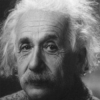
Albert Einstein
Albert Einstein; 14 March 1879 – 18 April 1955) was a German-born theoretical physicist. He developed the general theory of relativity, one of the two pillars of modern physics.:274 Einstein's work is also known for its influence on the philosophy of science. Einstein is best known in popular culture for his mass–energy equivalence formula E = mc2. He received the 1921 Nobel Prize in Physics for his "services to theoretical physics", in particular his discovery of the law of the photoelectric...
NationalityGerman
ProfessionScientist
Date of Birth14 March 1879
CityUlm, Germany
CountryGermany
Any man who reads too much and uses his own brain too little falls into lazy habits of thinking.
If people are good only because they fear punishment, and hope for reward, then we are a sorry lot indeed.
Anyone who has never made a mistake has never tried anything new.
Everything should be made as simple as possible, but not simpler.
Science is 1% inspiration and 99% perspiration.
The question hat drives me hazy: Am I or the others crazy?
... the desire for truth must take precedence over all other desires.
Is it not a terrible thing to be forced by society to do things which all of us as individuals regard as abominable crimes?
We scientists, whose tragic destination has been to help in making the methods of annihilation more gruesome and more effective, must consider it our solemn and transcendent duty to do all in our power in preventing these weapons from being used for the brutal purpose for which they were invented.
Every serious scientific worker is painfully conscious of this involuntary relegation to an ever-narrowing sphere of knowledge, which threatens to deprive the investigator of his broad horizon and degrades him to the level of a mechanic.
... we will hope that future historians will explain the morbid symptoms of present-day society as the childhood ailments of an aspiring humanity, due entirely to the excessive speed at which civilization was advancing.
It is an outcome of faith that nature-as she is perceptible to our five senses-takes the character of such a well formulated puzzle.
There is, however, one other human right which is infrequently mentioned but which seems to be destined to become very important: this is the right, or the duty, of the individual to abstain from cooperating in activities which he considers wrong or pernicious.
It is characteristic of the military mentality that non-human factors ... are held essential, while the human being, his desires and thoughts-in short, the psychological factors-are considered as unimportant and secondary.