Albert Einstein
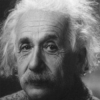
Albert Einstein
Albert Einstein; 14 March 1879 – 18 April 1955) was a German-born theoretical physicist. He developed the general theory of relativity, one of the two pillars of modern physics.:274 Einstein's work is also known for its influence on the philosophy of science. Einstein is best known in popular culture for his mass–energy equivalence formula E = mc2. He received the 1921 Nobel Prize in Physics for his "services to theoretical physics", in particular his discovery of the law of the photoelectric...
NationalityGerman
ProfessionScientist
Date of Birth14 March 1879
CityUlm, Germany
CountryGermany
People should be more like animals . . . they should be more intuitive; they should not be too conscious of what they do while they do it.
A life directed chiefly toward the fulfillment of personal desires will sooner or later always lead to bitter disappointment.
Failing isn't bad when you learn what not to do.
The harmony of natural law reveals an Intelligence of such superiority that, compared with it, all the systematic thinking and acting of human beings is an utterly insignificant reflection.
Everybody acts not only under external compulsion but also in accordance with inner necessity.
Remember today, for it is the beginning of always. Today marks the start of a brave new future filled with all your dreams can hold. Think truly to the future and make those dreams come true.
Creativity is intelligence having fun.
I do not believe in free will. Schopenhauer's words: 'Man can do what he wants, but he cannot will what he wills,' accompany me in all situations throughout my life and reconcile me with the actions of others, even if they are rather painful to me. This awareness of the lack of free will keeps me from taking myself and my fellow men too seriously as acting and deciding individuals, and from losing my temper.
Scientific research can reduce superstition by encouraging people to think and view things in terms of cause and effect.
What use are socks? They only produce holes.
I agree with your remark about loving your enemy as far as actions are concerned. But for me the cognitive basis is the trust in an unrestricted causality. 'I cannot hate him, because he must do what he does.' That means for me more Spinoza than the prophets.
Have the courage to take your own thoughts seriously, for they will shape you.
More and more I come to value charity and love of one's fellow being above everything else...All our lauded technological progress-our very civilization-is like the axe in the hand of the pathological criminal.
I see in Nature a magnificent structure... that must fill a thinking person with a feeling of humility...