Albert Einstein
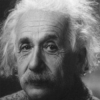
Albert Einstein
Albert Einstein; 14 March 1879 – 18 April 1955) was a German-born theoretical physicist. He developed the general theory of relativity, one of the two pillars of modern physics.:274 Einstein's work is also known for its influence on the philosophy of science. Einstein is best known in popular culture for his mass–energy equivalence formula E = mc2. He received the 1921 Nobel Prize in Physics for his "services to theoretical physics", in particular his discovery of the law of the photoelectric...
NationalityGerman
ProfessionScientist
Date of Birth14 March 1879
CityUlm, Germany
CountryGermany
The payment of the worker is not determined by the value of his product.
The supreme task of the physicist is to arrive at those universal elementary laws from which the cosmos can be built up by pure deduction. There is no logical path to these laws; only intuition, resting on sympathetic understanding of experience, can reach them.
A hundred times every day I remind myself that my inner and outer life are based on the labors of others.
To have security against atomic bombs and against the other biological weapons, we have to prevent war, for if we cannot prevent war every nation will use every means that is at their disposal; and in spite of all promises they make, they will do it. At the same time, so long as war is not prevented, all the governments of the nations have to prepare for war, and if you have to prepare for war, then you are in a state where you cannot abolish war.
I do not much believe in education. Each person ought to be his or her own model, however frightful that may be.
To be sure, it is not the fruits of scientific research that elevate a man and enrich his nature, but the urge to understand, the intellectual work, creative or receptive.
The scientist finds his reward in what Henri Poincare calls the joy of comprehension, and not in the possibility of application to which any discovery may lead.
The enormous mental resilience, without which no Chess player can exist, was so much taken up by Chess that he could never free his mind of this game
I have always disliked the fierce competitive spirit embodied in that highly intellectual game.
Most people stop looking when they find the proverbial needle in the haystack. I would continue looking to see if there were other needles.
We must recognize what in our accepted tradition is damaging to our fate and dignity-and shape our lives accordingly.
I very rarely think in words at all. A thought comes, and I may try to express in words afterwards.
The only way to escape the corruptible effect of praise is to go on working.
Truly novel inventions emerge only in one's youth. Later one becomes ever more experienced, famous-and foolish.