Albert Einstein
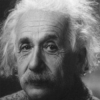
Albert Einstein
Albert Einstein; 14 March 1879 – 18 April 1955) was a German-born theoretical physicist. He developed the general theory of relativity, one of the two pillars of modern physics.:274 Einstein's work is also known for its influence on the philosophy of science. Einstein is best known in popular culture for his mass–energy equivalence formula E = mc2. He received the 1921 Nobel Prize in Physics for his "services to theoretical physics", in particular his discovery of the law of the photoelectric...
NationalityGerman
ProfessionScientist
Date of Birth14 March 1879
CityUlm, Germany
CountryGermany
We have penetrated far less deeply into the regularities obtaining within the realm of living things, but deeply enough nevertheless to sense at least the rule of fixed necessity... what is still lacking here is a grasp of the connections of profound generality, but not a knowledge of order itself.
Economists and workplace consultants regard it as almost unquestioned dogma that people are motivated by rewards, so they don't feel the need to test this. It has the status more of religious truth than scientific hypothesis. The facts are absolutely clear. There is no question that in virtually all circumstances in which people are doing things in order to get rewards, extrinsic tangible rewards undermine intrinsic motivation.The bonus myth: How paying for results can backfire The world is a dangerous place, not because of those who do evil, but because of those who look on and do nothing.
The field is the sole influence of the particle.
E=mc2. Energy equals mass times the speed of light squared. The original statement is: If a body gives off the energy L in the form of radiation, its mass diminishes by L/c2. Ist die Tragheit eines Korpers von Seinem Energieghalt Abhangig? 1905
The world is not full of evil because of those who do wrong. It is full of evil because of those who do nothing.
Everybody felt his superiority, but nobody felt oppressed by it. Though he had no illusions about people and human affairs, he was full of kindness toward everybody and everything. Never did he give the impression of domineering, always of serving and helping. He was extremely conscientious, without allowing anything to assume undue importance; a subtle humor guarded him, which was reflected in his eyes and in his smile.
The series of integers is obviously an invention of the human mind, a self-created tool which simplifies the ordering of certain sensory experiences.
But there is another reason for the high repute of mathematics: it is mathematics that offers the exact natural sciences a certain measure of security which, without mathematics, they could not attain.
A thousand things can prove me right and one can prove me wrong.
Communities tend to be guided less than individuals by conscience and a sense of responsibility. How much misery does this fact cause mankind! It is the source of wars and every kind of oppression, which fill the earth with pain, sighs and bitterness.
Figuring out how to think about the problem.
Those who staying with the wrong reward,(eg. stay in comfort zone, etc.), long enough will get problem.
We believe that an informed citizenry will act for life and not for death.
A man's moral worth is not measured by what his religious beliefs are but rather by what emotional impulses he has received from Nature during his lifetime.