Thomas Jefferson
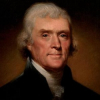
Thomas Jefferson
Thomas Jeffersonwas an American Founding Father who was the principal author of the Declaration of Independence. He was elected the second Vice President of the United States, serving under John Adams and in 1800 was elected the third President. Jefferson was a proponent of democracy, republicanism, and individual rights, which motivated American colonists to break from Great Britain and form a new nation. He produced formative documents and decisions at both the state and national level...
NationalityAmerican
ProfessionUS President
Date of Birth13 April 1743
CityShadwell, VA
CountryUnited States of America
The selfish spirit of commerce knows no country, and feels no passion of principle but that of gain
the qualifications for self-government in society are not innate. they are the result of habit and long training.
The selfish spirit of commerce, which knows no country, and feels no passion or principle but that of gain.
I set out on this ground which I suppose to be self-evident, that the earth belongs in usufruct to the living. . . . We seem not to perceive that, by the law of nature, one generation is to another as one independent nation is to another. . . . The earth belongs always to the living generations.
Self-love . . . is the sole antagonist of virtue, leading us constantly by our propensities to self-gratification in violation of our moral duties to others.
The present generation has the same right of self-government which the past one has exercised for itself.
I rejoice when I hear of young men of virtue and talents, worthy to receive and likely to preserve the splendid inheritance of self- government, which we have acquired and shaped for them.
How soon the labor of men would make a paradise of the earth were it not for misgovernment and a diversion of his energies to selfish interests.
I set out on this ground, which I suppose to be self evident, "that the earth belongs in usufruct to the living": that the dead have neither powers nor rights over it.
I deem no government safe which is under the vassalage of any self-constituted authorities, or any other authority than that of the nation, or its regular functionaries.
[We should be] determined... to sever ourselves from the union we so much value rather than give up the rights of self-government... in which alone we see liberty, safety and happiness.
We act not for ourselves but for the whole human race. The event of our experiment is to show whether man can be trusted with self - government.
How much pain they have cost us, the evils which have never happened.
The patriot, like the Christian, must learn to bear revilings and persecutions as a part of his duty; and in proportion as the trial is severe, firmness under it becomes more requisite and praiseworthy. It requires, indeed, self-command. But that will be fortified in proportion as the calls for its exercise are repeated.