Thomas Jefferson
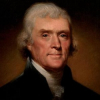
Thomas Jefferson
Thomas Jeffersonwas an American Founding Father who was the principal author of the Declaration of Independence. He was elected the second Vice President of the United States, serving under John Adams and in 1800 was elected the third President. Jefferson was a proponent of democracy, republicanism, and individual rights, which motivated American colonists to break from Great Britain and form a new nation. He produced formative documents and decisions at both the state and national level...
NationalityAmerican
ProfessionUS President
Date of Birth13 April 1743
CityShadwell, VA
CountryUnited States of America
If we believe that he (Jesus Christ) really countenanced the follies, the falsehoods, and the charlatanisms, which his biographers father upon him, and admit the misconstructions, interpolations, and theorizations of the fathers of the early and the
among the values of classical learning I estimate the Luxury of reading the Greek & Roman authors in all the beauties of their originals ... I think myself more indebted to my father for this, than for all the other luxuries his cares and affections have placed within my reach.
I shall need, too, the favor of that Being in whose hands we are, who led our fathers, as Israel of old, from their native land and planted them in a country flowing with all the necessaries of comforts of life...
In our own native land, in defense of the freedom that is our birthright and which we ever enjoyed till the late violation of it. For the protection of our property, acquired solely by the honest industry of our fore-fathers and ourselves, against violence actually offered, we have taken up arms. We shall lay them down when hostilities shall cease on the part of the aggressors, and all danger of their being renewed shall be removed, and not before.
If we could believe that Jesus...countenanced the follies, falsehoods and charlatanisms which his biographers father on him, ...the conclusion would be irresistible...that he was an imposter.
To take a single step beyond the boundaries specially drawn around the powers of Congress is to take possession of a boundless field of power, no longer susceptible to definition.
When I contemplate the immense advances in science and discoveries in the arts which have been made within the period of my life, I look forward with confidence to equal advances by the present generation, and have no doubt they will consequently be as much wiser than we have been as we than our fathers were, and they than the burners of witches.
Having labored faithfully in establishing the right of self-government, we see in the rising generation, into whose hands it is passing, that purity of principle and energy of character which will protect and preserve it through their day, and deliver it over to their sons as they receive it from their fathers.
What but education has advanced us beyond the condition of our indigenous neighbors? And what chains them to their present state of barbarism and wretchedness but a bigoted veneration for the supposed superlative wisdom of their fathers and the preposterous idea that they are to look backward for better things and not forward, longing, as it should seem, to return to the days of eating acorns and roots rather than indulge in the degeneracies of civilization?
This doctrine ['that the condition of man cannot be ameliorated, that what has been must ever be, and that to secure ourselves where we are we must tread with awful reverence in the footsteps of our fathers']is the genuine fruit of the alliance between Church and State, the tenants of which finding themselves but too well in their present condition, oppose all advances which might unmask their usurpations and monopolies of honors, wealth and power, and fear every change as endangering the comforts they now hold.
If we believe that he [Jesus Christ]really countenanced the follies, the falsehoods, and the charlatanisms, which his biographers [writers of the New Testament]father upon him, and admit the misconstructions, interpolations, and theorizations of the fathers of the early and the fanatics of the latter ages, the conclusion would be irresistible by every sound mind that he was an impostor.
It is better to tolerate the rare instance of a parent refusing to let his child be educated, than to shock the common feelings and ideas by forcible asportation and education of the infant against the will of the father.
To take from one because it is thought that his own industry and that of his father's has acquired too much, in order to spare to others, who, or whose fathers have not exercised equal industry and skill, is to violate arbitrarily the first principle of association-the guarantee to every one of a free exercise of his industry and the fruits acquired by it.
Take more pleasure in giving what is best to another than in having it for yourself, and then all the world will love you.