Thomas Jefferson
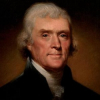
Thomas Jefferson
Thomas Jeffersonwas an American Founding Father who was the principal author of the Declaration of Independence. He was elected the second Vice President of the United States, serving under John Adams and in 1800 was elected the third President. Jefferson was a proponent of democracy, republicanism, and individual rights, which motivated American colonists to break from Great Britain and form a new nation. He produced formative documents and decisions at both the state and national level...
NationalityAmerican
ProfessionUS President
Date of Birth13 April 1743
CityShadwell, VA
CountryUnited States of America
Believing that happiness of mankind is best promoted by the useful pursuits of peace, that on these alone a stable prosperity can be founded, that the evils of war are great in their endurance, and have a long reckoning for ages to come, I have used
It is, however, an evil for which there is no remedy, our liberty depends on the freedom of the press, and that cannot be limited without being lost
Mankind are more disposed to suffer, while evils are sufferable, than to right themselves by abolishing the forms to which they are accustomed.
The declaration of rights [Bill of Rights] is, like all other human blessings, alloyed with some inconveniences and not accomplishing fully its object. But the good in this instance vastly outweighs the evil.
The States should be watchful to note every material usurpation on their rights; to denounce them as they occur in the most peremptory terms; to protest against them as wrongs to which our present submission shall be considered, not as acknowledgments or precedents of rights, but as a temporary yielding to the lesser evil, until their accumulation shall overweigh that of separation.
The evils of war are great in their endurance, and have a long reckoning for ages to come.
Hindsight is an exact science. Hold fast to your dreams, for it dreams die, life is a broken-winged bird that cannot fly. How much pain they have cost us, the evils which have never happened.
We are overdone with banking institutions, which have banished the precious metals, and substituted a more fluctuating and unsafe medium... These have withdrawn capital from useful improvements and employments to nourish idleness... These are evils more easily to be deplored than remedied.
When great evils happen, I am in the habit of looking out for what good may arise from them as consolations to us, and Providence has in fact so established the order of things, as that most evils are the means of producing some good.
Political dissension is doubtless a less evil than the lethargy of despotism: but still it is a great evil, and it would be as worthy the efforts of the patriot as of the philosopher, to exclude its influence if possible, from social life. The good are rare enough at best. There is no reason to subdivide them by artificial lines. But whether we shall ever be able so far to perfect the principles of society as that political opinions shall, in its intercourse, be as inoffensive as those of philosophy, mechanics, or any other, may well be doubted.
The only greater [evil] than separation... [is] living under a government of discretion.
Evil triumphs when good men do nothing.
It would reduce the whole instrument to a single phrase, that of instituting a Congress with power to do whatever would be for the good of the United States; and as they would be the sole judges of the good or evil, it would be also a power to do whatever evil they please . . . . Certainly no such universal power was meant to be given them. It [the Constitution] was intended to lace them up straightly within the enumerated powers and those without which, as means, these powers could not be carried into effect.
1.Never put off till to-morrow what you can do to-day. 2.Never trouble another for what you can do yourself. 3.Never spend your money before you have it. 4.Never buy what you do not want, because it is cheap; it will be dear to you. 5.Pride costs us more than hunger, thirst, and cold. 6.We never repent of having eaten too little. 7.Nothing is troublesome that we do willingly. 8.How much pain have cost us the evils which have never happened. 9.Take things always by their smooth handle. 10.When angry, count ten, before you speak; if very angry, a hundred.