Thomas Aquinas
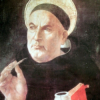
Thomas Aquinas
Thomas Aquinas, O.P., was an Italian Dominican friar, Catholic priest, and Doctor of the Church. He was an immensely influential philosopher, theologian, and jurist in the tradition of scholasticism, within which he is also known as the Doctor Angelicus and the Doctor Communis. The name Aquinas identifies his ancestral origins in the county of Aquino in present-day Lazio, where his family held land until 1137...
NationalityItalian
ProfessionTheologian
CountryItaly
two acts-of-love persons
An act of love always tends towards two things; to the good that one wills, and to the person for whom one wills it.
mean two evil
It seems that God does not exist; because if one of two contraries be infinite, the other would be altogether destroyed. But the word "God" means that He is infinite goodness. If, therefore, God existed, there would be no evil discoverable; but there is evil in the world. Therefore God does not exist.
christian men two
Man can sin against nature in two ways. First, when he sins against his specific rational nature, acting contrary to reason. In this sense, we can say that every sin is a sin against man's nature, because it is against man's right reason....
teaching two sacred-scripture
In questions of this sort there are two things to be observed. First, that the truth of the Scriptures be inviolably maintained. Secondly, since Scripture doth admit of diverse interpretations, that no one cling to any particular exposition with such pertinacity that, if what he supposed to be the teaching of Scripture should afterward turn out to be clearly false, he should nevertheless still presume to put it forward, lest thereby the sacred Scriptures should be exposed to the derision of unbelievers and the way of salvation should be closed to them.
mistake two errors
Mistakes are made on two counts: an argument is either based on error or incorrectly developed.
mean two done
If a thing can be done adequately by means of one, it is superfluous to do it by means of several; for we observe that nature does not employ two instruments [if] one suffices.
sheep two suffering
If you seek patience, you will find no better example than the cross. Great patience occurs in two ways: either when one patiently suffers much, or when one suffers things which one is able to avoid and yet does not avoid. Christ endured much on the cross, and did so patiently, because when he suffered he did not threaten; he was led like a sheep to the slaughter and he did not open his mouth.
american-comedian care certain common ordinance reason
Law is nothing other than a certain ordinance of reason for the common good, promulgated by the person who has the care of the community.
men heaven saving
O saving Victim, opening wide The gate of heaven to man below, Our foes press on from every side, Thine aid supply, Thy strength bestow.
father greatness men
To restore man, who had been laid low by sin, to the heights of divine glory, the Word of the eternal Father, though containing all things within His immensity, willed to become small. This He did not by putting aside His greatness but by taking to Himself our littleness.
taught teach theology
Theology is taught by God, teaches God, and leads to God.
heart divine-help helping
We can open our hearts to God, but only with Divine help.
order tasks preacher
To teach in order to lead others to faith is the task of every preacher and of each believer.
pain fire doe
The fire of hell is called eternal, only because it never ends. Still, there is change in the pains of the lost...Hence in hell true eternity does not exist, but rather time.