Sigmund Freud
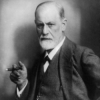
Sigmund Freud
Sigmund Freudwas an Austrian neurologist and the founder of psychoanalysis, a clinical method for treating psychopathology through dialogue between a patient and a psychoanalyst. Freud was born to Galician Jewish parents in the Moravian town of Freiberg, in the Austro-Hungarian Empire. He qualified as a doctor of medicine in 1881 at the University of Vienna. Upon completing his habilitation in 1885, he was appointed a docent in neuropathology and became an affiliated professor in 1902. Freud lived and worked in...
NationalityAustrian
ProfessionScientist
Date of Birth6 May 1856
CityPribor, Czech Republic
CountryAustria
When the wayfarer whistles in the dark, he may be disavowing his timidity, but he does not see any the more clearly for doing so.
I should like to raise the question whether the inevitable stunting of the sense of smell as a result of man's turning away from the earth, and the organic repression of the smell-pleasure produced by it, does not largely share in his predisposition to nervous diseases.
One becomes gradually accustomed to a new realization of the nature of 'happiness': one has to assume happiness when Fate does not carry out all its threats simultaneously.
The Devil would be the best way out as an excuse for God; in that way he would be playing the same part as an agent of economic discharge as the Jew does in the world of the Aryan ideal. But even so, one can hold God responsible for the existence of the Devil just as well as for the existence of the wickedness which the Devil embodies.
The individual does actually carry on a double existence: one designed to serve his own purposes and another as a link in a chain, in which he serves against, or at any rate without, any volition of his own.
A love that does not discriminate seems to me to forfeit a part of its own value, by doing an injustice to its object; and secondly, not all men are worthy of love.
He does not believe that does not live according to his belief.
Nature delights in making use of the same forms in the most various biological connections: as it does, for instance, in the appearance of branch-like structures both in coral and in plants, and indeed in some forms of crystal and in certain chemical precipitates.
When one does not have what one wants, one must want what one has.
Where does a thought go when it's forgotten?
We are so made that we can derive intense enjoyment from a contrast and very little from a state of things.
At the bottom God is nothing more than an exalted father
I have found little that is ''good'' about human beings on the whole. In my experience most of them are trash, no matter whether they publicly subscribe to this or that ethical doctrine or to none at all. That is something that you cannot say aloud, or perhaps even think.
I have found little that is good about human beings. In my experience most of them, on the whole, are trash.