Samuel Johnson
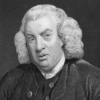
Samuel Johnson
Samuel Johnson, often referred to as Dr Johnson, was an English writer who made lasting contributions to English literature as a poet, essayist, moralist, literary critic, biographer, editor and lexicographer. Johnson was a devout Anglican and committed Tory, and has been described as "arguably the most distinguished man of letters in English history". He is also the subject of "the most famous single biographical work in the whole of literature," James Boswell's Life of Samuel Johnson...
NationalityEnglish
ProfessionNon-Fiction Author
Date of Birth18 September 1709
Sir, they are a race of convicts, and ought to be thankful for anything we allow them short of hanging.
Sir, they are a race of convicts and ought to be grateful for anything we allow them short of hanging.
Men who have flattered themselves into this opinion of their own abilities, look down on all who waste their lives over books, as a race of inferior beings condemned by nature to perpetual pupilage, and fruitlessly endeavouring to remedy their barrenness by incessant cultivation, or succour their feebleness by subsidiary strength. They presume that none would be more industrious than they, if they were not more sensible of deficiences; and readily conclude, that he who places no confidence in his own powers owes his modesty only to his weakness.
Life of Ages, richly poured, Love of God unspent and free, Flowing in the Prophet's word And the People's liberty! Never was to chosen race That unstinted tide confined; Thine is every time and place, Fountain sweet of heart and mind!
There is a certain race of men that either imagine it their duty, or make it their amusement, to hinder the reception of every work of learning or genius, who stand as sentinels in the avenues of fame, and value themselves upon giving Ignorance and Envy the first notice of a prey.
Luxury, so far as it reaches the people, will do good to the race of people; it will strengthen and multiply them. Sir, no nation was ever hurt by luxury; for, as I said before; it can reach but a very few.
What signifies protesting so against flattery! when a person speaks well of one, it must either be true or false, you know; if true, let us rejoice in his good opinion; if he lies, it is a proof at least that he loves more to please me, than to sit s
To act from pure benevolence is not possible for finite human beings, Human benevolence is mingled with vanity, interest, or some other motive.
With regard to the sharpest and most melting sorrow, that which arises from the loss of those whom we have loved with tenderness, it may be observed, that friendship between mortals can be contracted on no other terms than that one must some time mou
Every quotation contributes something to the stability or enlargement of the language.
Beauty has often overpowered the resolutions of the firm, and the reasonings of the wise, roused the old to sensibility, and subdued the rigorous to softness
As the Spanish proverb says, ''He who would bring home the wealth of the Indies, must carry the wealth of the Indies with him.'' So it is in travelling; a man must carry knowledge with him, if he would bring home knowledge.
Few things are impossible to diligence and skill. Great works are performed not by strength, but perseverance.
When a man is tired of London, he is tired of life; for there is in London all that life can afford