Samuel Johnson
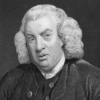
Samuel Johnson
Samuel Johnson, often referred to as Dr Johnson, was an English writer who made lasting contributions to English literature as a poet, essayist, moralist, literary critic, biographer, editor and lexicographer. Johnson was a devout Anglican and committed Tory, and has been described as "arguably the most distinguished man of letters in English history". He is also the subject of "the most famous single biographical work in the whole of literature," James Boswell's Life of Samuel Johnson...
NationalityEnglish
ProfessionNon-Fiction Author
Date of Birth18 September 1709
Integrity without knowledge is weak and useless. Knowledge without integrity is dangerous and dreadful.
These are the men who, without virtue, labour, or hazard, are growing rich, as their country is impoverished; they rejoice, when obstinacy or ambition adds another year to slaughter and devastation; and laugh, from their desks, at bravery and science, while they are adding figure to figure, and cipher to cipher, hoping for a new contract from a new armament, and computing the profits of a siege or tempest.
Integrity without knowledge is weak and useless, and knowledge without integrity is dangerous and dreadful.
Marriage is the strictest tie of perpetual friendship, and there can be no friendship without confidence, and no confidence without integrity; and he must expect to be wretched, who pays to beauty, riches, or politeness that regard which only virtue and piety can claim.
In matters of business, no woman stops at integrity.
Economy is the parent of integrity, of liberty, and of ease, and the beauteous sister of temperance, of cheerfulness and health.
The fortitude which has encountered no dangers, that prudence which has surmounted no difficulties, that integrity which has been attacked by no temptation, can at best be considered but as gold not yet brought to the test, of which therefore the true value cannot be assigned.
The whole power of cunning is privative; to say nothing, and to do nothing , is the utmost of its reach. Yet men, thus narrow by nature and mean by art, are sometimes able to rise by the miscarriages of bravery and the openness of integrity, and, watching failures and snatching opportunities, obtain advantages which belong to higher characters.
What signifies protesting so against flattery! when a person speaks well of one, it must either be true or false, you know; if true, let us rejoice in his good opinion; if he lies, it is a proof at least that he loves more to please me, than to sit s
To act from pure benevolence is not possible for finite human beings, Human benevolence is mingled with vanity, interest, or some other motive.
With regard to the sharpest and most melting sorrow, that which arises from the loss of those whom we have loved with tenderness, it may be observed, that friendship between mortals can be contracted on no other terms than that one must some time mou
Every quotation contributes something to the stability or enlargement of the language.
Beauty has often overpowered the resolutions of the firm, and the reasonings of the wise, roused the old to sensibility, and subdued the rigorous to softness
As the Spanish proverb says, ''He who would bring home the wealth of the Indies, must carry the wealth of the Indies with him.'' So it is in travelling; a man must carry knowledge with him, if he would bring home knowledge.