Samuel Johnson
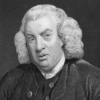
Samuel Johnson
Samuel Johnson, often referred to as Dr Johnson, was an English writer who made lasting contributions to English literature as a poet, essayist, moralist, literary critic, biographer, editor and lexicographer. Johnson was a devout Anglican and committed Tory, and has been described as "arguably the most distinguished man of letters in English history". He is also the subject of "the most famous single biographical work in the whole of literature," James Boswell's Life of Samuel Johnson...
NationalityEnglish
ProfessionNon-Fiction Author
Date of Birth18 September 1709
Claret is the liquor for boys; port, for men; but he who aspires to be a hero must drink brandy
Sir, I have no objection to a man's drinking wine, if he can do it in moderation. I found myself apt to go to excess in it, and therefore, after having been for some time without it, on account of illness, I thought it better not to return to it. Every man is to judge for himself, according to the effects which he experiences.
Tea's proper use is to amuse the idle, and relax the studious, and dilute the full meals of those who cannot use exercise, and will not use abstinence.
He who aspires to be a serious wine drinker must drink claret.
Wine gives a man nothing. It neither gives him knowledge nor wit; it only animates a man, and enables him to bring out what a dread of the company has repressed. It only puts in motion what had been locked up in frost.
That all who are happy are equally happy is not true. A peasant and a philosopher may be equally satisfied, but not equally happy. A small drinking glass and a large one may be equally full, but the large one holds more than the small.
There are some sluggish men who are improved by drinking; as there are fruits that are not good until they are rotten.
Wine gives a man nothing... it only puts in motion what had been locked up in frost.
Wine makes a man more pleased with himself; I do not say it makes him more pleasing to others.
One of the disadvantages of wine is that it makes a man mistake words for thoughts.
Melancholy, indeed, should be diverted by every means but drinking.
What signifies protesting so against flattery! when a person speaks well of one, it must either be true or false, you know; if true, let us rejoice in his good opinion; if he lies, it is a proof at least that he loves more to please me, than to sit s
To act from pure benevolence is not possible for finite human beings, Human benevolence is mingled with vanity, interest, or some other motive.
With regard to the sharpest and most melting sorrow, that which arises from the loss of those whom we have loved with tenderness, it may be observed, that friendship between mortals can be contracted on no other terms than that one must some time mou