Samuel Johnson
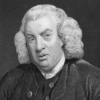
Samuel Johnson
Samuel Johnson, often referred to as Dr Johnson, was an English writer who made lasting contributions to English literature as a poet, essayist, moralist, literary critic, biographer, editor and lexicographer. Johnson was a devout Anglican and committed Tory, and has been described as "arguably the most distinguished man of letters in English history". He is also the subject of "the most famous single biographical work in the whole of literature," James Boswell's Life of Samuel Johnson...
NationalityEnglish
ProfessionNon-Fiction Author
Date of Birth18 September 1709
He is not only dull himself, he is the cause of dullness in others
In all evils which admit a remedy, impatience should be avoided, because it wastes that time and attention in complaints which, if properly applied, might remove the cause
One cause, which is not always observed, of the insufficiency of riches, is that they very seldom make their owner rich.
It is certain that success naturally confirms in us a favourable opinion of our own abilities. Scarce any man is willing to allot to accident, friendship, and a thousand causes, which concur in every event without human contrivance or interposition, the part which they may justly claim in his advancement. We rate ourselves by our fortune rather than our virtues, and exorbitant claims are quickly produced by imaginary merit.
There is no observation more frequently made by such as employ themselves in surveying the conduct of mankind, than that marriage, though the dictate of nature, and the institution of Providence, is yet very often the cause of misery, and that those who enter into that state can seldom forbear to express their repentance, and their envy of those whom either chance or caution hath withheld from it.
Their origin is commonly unknown; for the practice often continues when the cause has ceased, and concerning superstitious ceremonies it is in vain to conjecture; for what reason did not dictate, reason cannot explain.
The general remedy of those who are uneasy without knowing the cause is change of place.
What signifies protesting so against flattery! when a person speaks well of one, it must either be true or false, you know; if true, let us rejoice in his good opinion; if he lies, it is a proof at least that he loves more to please me, than to sit s
To act from pure benevolence is not possible for finite human beings, Human benevolence is mingled with vanity, interest, or some other motive.
With regard to the sharpest and most melting sorrow, that which arises from the loss of those whom we have loved with tenderness, it may be observed, that friendship between mortals can be contracted on no other terms than that one must some time mou
Every quotation contributes something to the stability or enlargement of the language.
Beauty has often overpowered the resolutions of the firm, and the reasonings of the wise, roused the old to sensibility, and subdued the rigorous to softness
As the Spanish proverb says, ''He who would bring home the wealth of the Indies, must carry the wealth of the Indies with him.'' So it is in travelling; a man must carry knowledge with him, if he would bring home knowledge.
Few things are impossible to diligence and skill. Great works are performed not by strength, but perseverance.