Pope Benedict XVI
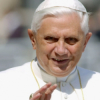
Pope Benedict XVI
Pope Benedict XVIserved as pope of the Catholic Church from 2005 to 2013. He was elected pope on 19 April 2005, was inaugurated on 24 April 2005 and resigned from the office on 28 February 2013. Benedict's election occurred in a papal conclave following the death of Pope John Paul II...
NationalityGerman
ProfessionReligious Leader
Date of Birth16 April 1927
CityMarktl, Germany
CountryGermany
men law foundation
No law made by man can overturn that of the Creator without dramatically affecting society in its very foundation.
men order law
When human affairs are so ordered that there is no recognition of God, there is a belittling of man. That is why, in the final analysis, worship and law cannot be completely separated from each other. God has a right to a response from man, to man himself, and where that right of God totally disappears, the order of law among men is dissolved, because there is no cornerstone to keep the whole structure together.
law church speech
It is deplorable that homosexual persons have been and are the object of violent malice in speech or in action. Such treatment deserves condemnation from the church's pastors wherever it occurs. ... The intrinsic dignity of each person must always be respected in work, in action and in law.
men law organization
Islam has a total organization of life that is completely different from ours; it embraces simply everything,...There is a very marked subordination of woman to man; there is a very tightly knit criminal law, indeed, a law regulating all areas of life, that is opposed to our modern ideas about society. One has to have a clear understanding that it is not simply a denomination that can be included in the free realm of a pluralistic society.
life outpouring source
The outpouring of Christ's blood is the source of the church's life.
above consoles lord means work
The fact that the Lord can work and act even with insufficient means consoles me, and above all I entrust myself to your prayers.
assume entering freedom name relations responsibility
In the name of freedom, there has to be a correlation between rights and duties, by which every person is called to assume responsibility for his or her choices, made as a consequence of entering into relations with others.
against backdrop catholic council faith question reality
The reality of the Eucharistic sacrifice has always been at the heart of Catholic faith; called into question in the 16th century, it was solemnly reaffirmed at the Council of Trent against the backdrop of our justification in Christ.
church draws god good goodness great guides infinite judge present responsibility truly truth
It's a great responsibility before God, the judge who guides us, who draws us to truth and good, and in this sense the church must unmask evil, rendering present the goodness of God, rendering present his truth, the truly infinite for which we are thirsty.
great
When the danger is great, one must not run away.
cannot effective means ourselves personally render transmit
I would say it simply: No one can give that which he doesn't personally possess, which means we cannot transmit the Holy Spirit in an effective way, render the Spirit perceptible, if we ourselves aren't close to the Spirit.
above correct create form great help homosexual legal people respect suffer
Above all, we must have great respect for these people who also suffer and who want to find their own way of correct living. On the other hand, to create a legal form of a kind of homosexual marriage, in reality, does not help these people.
boundless gave god joy love loved
I would like everyone to feel loved by the God who gave his son for us and showed us his boundless love. I want everyone to feel the joy of being Christian.
brings citizen clearly dimension expression freedom human include individual religious understood
Human rights, of course, must include the right to religious freedom, understood as the expression of a dimension that is at once individual and communitarian - a vision that brings out the unity of the person while clearly distinguishing between the dimension of the citizen and that of the believer.