Ludwig von Mises
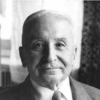
Ludwig von Mises
Ludwig Heinrich Edler von Miseswas a theoretical Austrian School economist. He is best known for his work on praxeology, a study of human choice and action. Mises emigrated from Austria to the United States in 1940. Mises's writings have exerted significant influence on the libertarian movement in the United States since the mid-20th century...
NationalityAustrian
ProfessionEconomist
Date of Birth29 September 1881
CountryAustria
government self views
Welfare policies never attain those - allegedly beneficial - ends which the government and the self-styled progressives who advocated them wanted to attain, but - on the contrary - bring about a state of affairs which - from the very point of view of the government and its supporters - is even more unsatisfactory than the previous state of affairs they wanted to 'improve.'
men self fellow-man
What impels every man to the utmost exertion in the service of his fellow man. Is, in the market not compulsion on the part of gendarmes, hangmen and penal courts, it is self interest.
self height certain
Every specific tax, as well as the nation's whole tax system, becomes self-defeating above a certain height of the rates.
selfishness incentives laziness
Under a socialist mode of production all personal incentives which selfishness provides under capitalism are removed, and a premium is put upon laziness and negligence. Whereas in a capitalist society selfishness incites everyone to the utmost diligence, in a socialist society it makes for inertia and laxity.
teacher self genius
A genius is always a teacher, never a pupil; he is always self-made.
running selfish division-of-labor
What makes the existence and the evolution of society possible is precisely the fact that peaceful cooperation under the social division of labor in the long run best serves the selfish concerns of all individuals. The eminence of the market society is that its whole functioning and operation is the consummation of this principle.
hard-work doctors self
Many who are self-taught far excel the doctors, masters, and bachelors of the most renowned universities.
goal common socialism
Socialism and interventionism. Both have in common the goal of subordinating the individual unconditionally to the state.
mean liberty finals
There is no means of avoiding the final collapse of a boom brought about by credit expansion. The alternative is only whether the crisis should come sooner as the result of voluntary abandonment of further credit expansion, or later as a final and total catastrophe of the currency system involved.
struggle political police
The main political problem is how to prevent the police power from becoming tyrannical. This is the meaning of all the struggles for liberty.
war fighting wish
Whoever wishes peace among peoples must fight statism.
order entrepreneur benefits
The consumers are merciless. They never buy in order to benefit a less efficient producer and to protect him against the consequences of his failure to manage better. They want to be served as well as possible. And the working of the capitalist system forces the entrepreneur to obey the orders issued by the consumers.
book gun men
It is not the fault of the entrepreneurs that the consumers,the people, the common man,prefer liquor to Bibles and detective stories to serious books, and that governments prefer guns to butter. The entrepreneur does not make greater profits in selling bad things than in selling good things. His profits are the greater the better he succeeds in providing the consumers with those things they ask for most intensely.
running attitude real
The real bosses in the capitalist system of market economy are the consumers. They by their buying and by their abstention from buying decide who should own the capital and run the plants. They determine what should be produced and in what quantity and quality. Their attitudes result either in profit or in loss for the enterpriser. They make poor men rich and rich men poor. They are no easy bosses.