Ludwig von Mises
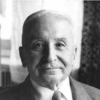
Ludwig von Mises
Ludwig Heinrich Edler von Miseswas a theoretical Austrian School economist. He is best known for his work on praxeology, a study of human choice and action. Mises emigrated from Austria to the United States in 1940. Mises's writings have exerted significant influence on the libertarian movement in the United States since the mid-20th century...
NationalityAustrian
ProfessionEconomist
Date of Birth29 September 1881
CountryAustria
division-of-labor people love-one-another
People do not cooperate under the division of labor because they love or should love one another. They cooperate because this best serves their own interests.
mean division-of-labor entrepreneur
Laissez faire does not mean: let soulless mechanical forces operate. It means: let individuals choose how they want to cooperate in the social division of labor and let them determine what the entrepreneurs should produce.
peace war division-of-labor
Modern society, based as it is on the division of labor, can be preserved only under conditions of lasting peace.
division-of-labor peaceful society
Every step by which an individual substitutes concerted action for isolated action results in an immediate and recognizable improvement in his conditions. The advantages derived from peaceful cooperation and division of labor are universal.
employment tendencies labor
There prevails on a free labor market a tendency toward full employment.
mean simple division-of-labor
Free markets. What does this system mean? The answer is simple: it is the market economy, it is the system in which the cooperation of individuals in the social division of labor is achieved by the market.
running selfish division-of-labor
What makes the existence and the evolution of society possible is precisely the fact that peaceful cooperation under the social division of labor in the long run best serves the selfish concerns of all individuals. The eminence of the market society is that its whole functioning and operation is the consummation of this principle.
civilization division-of-labor development
We owe the origin and development of human society and, consequently, of culture and civilization, to the fact that work performed under the division of labor is more productive than when performed in isolation.
mean division-of-labor liberty
The market economy is the social system of the division of labor under private ownership of the means of production. Everybody acts on his own behalf; but everybodys actions aim at the satisfaction of other peoples needs as well as at the satisfaction of his own. Everybody in acting serves his fellow citizens.
mean division-of-labor cooperation
Capitalism or market economy is that system of social cooperation and division of labor that is based on private ownership of the means of production.
war
War... is harmful, not only to the conquered but to the conqueror.
attitude conquer mind war
Only one thing can conquer war - that attitude of mind which can see nothing in war but destruction and annihilation.
goal common socialism
Socialism and interventionism. Both have in common the goal of subordinating the individual unconditionally to the state.
mean liberty finals
There is no means of avoiding the final collapse of a boom brought about by credit expansion. The alternative is only whether the crisis should come sooner as the result of voluntary abandonment of further credit expansion, or later as a final and total catastrophe of the currency system involved.