Joseph Conrad
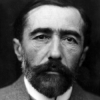
Joseph Conrad
Joseph Conradwas a Polish-British writer regarded as one of the greatest novelists to write in the English language. He joined the British merchant marine in 1878, and was granted British nationality in 1886. Though he did not speak English fluently until he was in his twenties, he was a master prose stylist who brought a non-English sensibility into English literature. He wrote stories and novels, many with a nautical setting, that depict trials of the human spirit in the midst...
NationalityPolish
ProfessionNovelist
Date of Birth3 December 1857
CountryPoland
A work that aspires, however humbly, to the condition of art should carry its justification in every line.
I don't like work no man does but I like what is in the work the chance to find yourself
All one's work might have been better done; but this is a sort of reflection a worker must put aside courageously if he doesn't mean every one of his conceptions to remain forever a private vision, an evanescent reverie.
I don't like work... but I like what is in work - the chance to find yourself. Your own reality - for yourself, not for others - which no other man can ever know.
We live as we dream--alone....
My task which I am trying to achieve is, by the power of the written word, to make you hear, to make you feel — it is, before all, to make you see. That — and no more, and it is everything. If I succeed, you shall find there according to your deserts: encouragement, consolation, fear, charm — all you demand; and, perhaps, also that glimpse of truth for which you have forgotten to ask.
The last thing a woman will consent to discover in a man whom she loves, or on whom she simply depends, is want of courage.
Between the conception and the creationbetween the emotion and the responseFalls the shadow
Between the conception and the creation between the emotion and the response Falls the shadow
As to honour you know it's a very fine mediaeval inheritance which women never got hold of. It wasn't theirs.
I dare say I am compelled, unconsciously compelled, now to write volume after volume, as in past years I was compelled to go to sea, voyage after voyage. Leaves must follow upon each other as leagues used to follow in the days gone by, on and on to the appointed end, which, being truth itself, is one -- one for all men and for all occupations.
I had ambition not only to go farther than any man had ever been before, but as far as it was possible for a man to go.
Remember, Razumov, that women, children, and revolutionists hate irony, which is the negation of all saving instincts, of all faith, of all devotion, of all action.
It is not Justice the servant of men, but accident, hazard, Fortune--the ally of patient Time--that holds an even and scrupulous balance.