John F. Kennedy
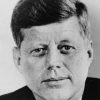
John F. Kennedy
John Fitzgerald "Jack" Kennedy, commonly referred to by his initials JFK, was an American politician who served as the 35th President of the United States from January 1961 until his assassination in November 1963. The Cuban Missile Crisis, The Bay of Pigs Invasion, the Nuclear Test Ban Treaty, the establishment of the Peace Corps, developments in the Space Race, the building of the Berlin Wall, the Trade Expansion Act to lower tariffs, and the Civil Rights Movement all took place...
NationalityAmerican
ProfessionPresident
Date of Birth29 May 1917
CountryUnited States of America
Economic growth without social progress lets the great majority of the people remain in poverty, while a privileged few reap the benefits of rising abundance.
Expansion and modernization of the nation's productive plant is essential to accelerate economic growth and to improve the international competitive position of American industry An early stimulus to business investment will promote recovery and increase employment.
The processes of growth are gradual, bearing fruit in a decade, not a day.
Our present tax system ... exerts too heavy a drag on growth ... It reduces the financial incentives for personal effort, investment, and risk-taking ... The present tax load ... distorts economic judgments and channels an undue amount of energy into efforts to avoidtaxliabilities.
Our progress as a nation can be no swifter than our progress in education. Our requirements for world leadership, our hopes for economic growth, and the demands of citizenship itself in an era such as this all require the maximum development of every young American's capacity. The human mind is our fundamental resource.
The path we have chosen for the present is full of hazards, as all paths are. The cost of freedom is always high, but Americans have always paid it. And one path we shall never choose, and that is the path of surrender, or submission.
A man does what he must - in spite of personal consequences, in spite of obstacles and dangers and pressures - and that is the basis of all human morality.
For in the final analysis, our most basic common link is that we all inhabit this small planet. We all breathe the same air. We all cherish our children's futures. And we are all mortal.
We cannot expect that all nations will adopt like systems, for conformity is the jailer of freedom and the enemy of growth.
Why should man's first flight to the moon be a matter of national competition? Why should the United States and the Soviet Union, in preparing for such expeditions, become involved in immense duplications of research, construction and expenditure?
For time and the world do not stand still. Change is the law of life. And those who look only to the past or the present are certain to miss the future.
The problems of the world cannot possibly be solved by skeptics or cynics whose horizons are limited by the obvious realities. We need men who can dream of things that never were.
I am the Democratic Party's candidate for president who happens also to be a Catholic. I do not speak for my church on public matters - and the church does not speak for me.
There is always inequity in life. Some men are killed in a war, and some men are wounded, and some men are stationed in the Antarctic and some are stationed in San Francisco. It's very hard in military or personal life to assure complete equality. Life