Janet Yellen
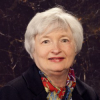
Janet Yellen
Janet Louise Yellenis an American economist. She is the Chair of the Board of Governors of the Federal Reserve System, previously serving as Vice Chair from 2010 to 2014. Previously, she was President and Chief Executive Officer of the Federal Reserve Bank of San Francisco; Chair of the White House Council of Economic Advisers under President Bill Clinton; and business professor at the University of California, Berkeley, Haas School of Business...
NationalityAmerican
ProfessionPolitician
Date of Birth13 August 1946
CityNew York City, NY
CountryUnited States of America
Stores don't order merchandise unless they think they can sell it right away. Manufacturers and builders don't produce unless they have buyers lined up. My business contacts describe this as a paradigm shift and they believe it's permanent.
While admirers of capitalism, we also to a certain extent believe it has limitations that require government intervention in markets to make them work.
They will simply be engaged in discussions of the Indonesian situation, and attempting to assess how things are going there and emphasizing the President's resolve that Indonesia take the necessary structural steps the IMF believes are necessary for recovery,
Uncertainty about sales impedes business planning and could harm capital formation just as much as uncertainty about inflation can create uncertainty about relative prices and harm business planning.
You are seeing some pass through of high energy and commodity prices, import prices, into core inflation.
The principle that a central bank, charged with controlling inflation, should be independent from the government is unassailable. It may also be true that it's easier for the central bank to guard its independence from political pressure when it mainly holds government securities.
We all remember the bad old days of the 1970s ... the Fed's response went down as one of the greatest monetary policy mistakes in my lifetime,
We all remember the bad old days of the 1970s ... It is stamped on the mind of central bankers,
This sector has been a key source of strength in the current expansion, and the concern is that, if house prices fell, the negative impact on household wealth could lead to a pullback in consumer spending.
Models used to describe and predict inflation commonly distinguish between changes in food and energy prices - which enter into total inflation - and movements in the prices of other goods and services - that is, core inflation.
One option that is clearly not on the table is allowing an unacceptable rise in inflation,
I wouldn't say we're completely out of the woods just yet. Indeed there are some issues that have the potential to be troublesome going forward.
Certainly, analyses do indicate that house prices are abnormally high --- that there is a 'bubble' element, even accounting for factors that would support high house prices, such as low mortgage interest rates. So a reversal is certainly a possibility.
Business students are very oriented to playing a role in the real world and accomplishing something, not training themselves to be scholars and contribute to the literature. Teaching in that kind of environment has focused me much more on the real world, how pieces of the theory I know can be applied to real-world situations.