George Bernard Shaw
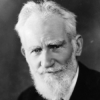
George Bernard Shaw
George Bernard Shaw, known at his insistence simply as Bernard Shaw, was an Irish playwright, critic and polemicist whose influence on Western theatre, culture and politics extended from the 1880s to his death and beyond. He wrote more than sixty plays, including major works such as Man and Superman, Pygmalionand Saint Joan. With a range incorporating both contemporary satire and historical allegory, Shaw became the leading dramatist of his generation, and in 1925 was awarded the Nobel Prize in Literature...
NationalityIrish
ProfessionPlaywright
Date of Birth26 July 1856
CityDublin, Ireland
CountryIreland
In socialism, private property is anathema, and equal distribution of income the first consideration. In capitalism, private property is cardinal, and distribution left to ensue from the play of free contract and selfish interest on that basis, no matter what anomalies it may present.
Socialism, reduced to its simplest legal and practical expression, means the complete discarding of the institution of private property by transforming it into public property, and the division of the resultant public income equally and indiscriminately among the entire population.
Gambling promises the poor what property performs for the rich, something for nothing.
Gambling promises the poor what property performs for the rich: something for nothing
Property is organized robbery.
When I was young I observed that nine out of every ten things I did were failures, so I did ten times more work
Vice is waste of life. Poverty, obedience and celibacy are the canonical vices.
Better a leader of Fabianism than a chorus man in parliament.
Even the fact that doctors themselves die of the very diseases they profess to cure passes unnoticed. We do not shoot out our lips and shake our heads, saying, 'They save others: themselves they cannot save':
Between persons of equal income there is no social distinction except the distinction of merit. Money is nothing: character, conduct, and capacity are everything. There would be great people and ordinary people and little people, but the great would always be those who had done great things, and never the idiots whose mothers had spoiled them and whose fathers had left them a hundred thousand a year; and the little would be persons of small minds and mean characters, and not poor persons who had never had a chance. That is why idiots are always in favor of inequality of income (their only chance of eminence), and the really great in favor of equality.
Beware of the pursuit of the Superhuman; it leads to an indiscriminate contempt for the human
Beauty is all very well at first sight; but who looks at it when it has been in the house three days?
The government who robs Peter to pay Paul can always depend on the support of Paul.
The great advantage of a hotel is that it's a great refuge from home life