Friedrich Nietzsche
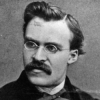
Friedrich Nietzsche
Friedrich Wilhelm Nietzschewas a German philosopher, cultural critic, poet and Latin and Greek scholar whose work has exerted a profound influence on Western philosophy and modern intellectual history. He began his career as a classical philologist before turning to philosophy. He became the youngest ever to hold the Chair of Classical Philology at the University of Basel in 1869, at the age of 24. Nietzsche resigned in 1879 due to health problems that plagued him most of his life, and...
NationalityGerman
ProfessionPhilosopher
Date of Birth15 October 1844
CityRocken, Germany
CountryGermany
Does wisdom perhaps appear on the earth as a raven which is inspired by the smell of carrion?
There is more wisdom in your body than in your best wisdom. And who then knows why your body needs precisely your best wisdom?
I no longer want to walk on worn soles.
Once and for all, there are many things I choose not to know.--Wisdom sets limits even to knowledge.
To become wise you have to want to experience certain experiences, and so to run into their open jaws. This is very dangerous, tobe sure; many a "wise man" has been eaten up in doing so.
It was modesty that invented the word "philosopher" in Greece and left the magnificent overweening presumption in calling oneselfwise to the actors of the spirit--the modesty of such monsters of pride and sovereignty as Pythagoras, as Plato.
Scholarship has the same relationship to wisdom as righteousness has to holiness: it is cold and dry, it is loveless and knows nodeep feelings of inadequacy or longing.
The flame is not as bright to itself as it is to those it illuminates: so too the sage.
My wisdom has long accumulated like a cloud, it becomes stiller and darker. So does all wisdom which shall one day bear lightnings.
It is not enough to prove something, one also has to seduce or elevate people to it. That is why the man of knowledge should learns how to speak his wisdom: and often in such a way that it sounds like folly!
The complete irresponsibility of man for his actions and his nature is the bitterest drop which he who understands must swallow.
Invisible threads are the strongest ties.
Whoever fights monsters should see to it that in the process he does not become a monster. And if you gaze long enough into an abyss, the abyss will gaze back into you.
There is more wisdom in your body than in your deepest philosophy.