Friedrich Nietzsche
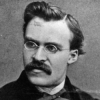
Friedrich Nietzsche
Friedrich Wilhelm Nietzschewas a German philosopher, cultural critic, poet and Latin and Greek scholar whose work has exerted a profound influence on Western philosophy and modern intellectual history. He began his career as a classical philologist before turning to philosophy. He became the youngest ever to hold the Chair of Classical Philology at the University of Basel in 1869, at the age of 24. Nietzsche resigned in 1879 due to health problems that plagued him most of his life, and...
NationalityGerman
ProfessionPhilosopher
Date of Birth15 October 1844
CityRocken, Germany
CountryGermany
When one does away with oneself one does the most estimable thing possible: one thereby almost deserves to live.
"State," I call it, where they all drink poison, the good and the wicked; "state," where they all lose themselves, the good and the wicked; "state," where they all call their slow suicide-"life."
The relatives of a suicide hold it against him that out of consideration for their reputation he did not remain alive.
Thinking about suicide is a potent consolation: it helps us to get through many a bad night.
It is always consoling to think of suicide: in that way one gets through many a bad night.
To die proudly when it is no longer possible to live proudly. Death freely chosen, death at the right time, brightly and cheerfully accomplished amid children and witnesses: then a real farewell is still possible, as the one who is taking leave is still there; also a real estimate of what one has wished, drawing the sum of one's life--all in opposition to the wretched and revolting comedy that Christianity has made of the hour of death.
The thought of suicide is a great source of comfort: with it a calm passage is to be made across many a bad night.
There is a certain right by which we many deprive a man of life, but none by which we may deprive him of death; this is mere cruelty.
When man does not have firm, calm lines on the horizon of his life- mountain and forest lines, as it were- then a man's innermost will becomes agitated, preoccupied, and wistful.
However modest one may be in one's demand for intellectual cleanliness, one cannot help feeling, when coming into contact with the New Testament, a kind of inexpressible discomfiture: for the unchecked impudence with which the least qualified want to raise their voice on the greatest problems, and even claim to be judges of things, surpasses all measure. The shameless levity with which the most intractable problems (life, world, God, purpose of life) are spoken of, as if they were not problems at all but simply things that these little bigots KNEW!
He who does not lie does not know what truth is.
Light for some time to come will have to be called darkness.
My humanity is a constant self-overcoming.
Man Is Something That Must Be Overcome