Friedrich Nietzsche
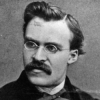
Friedrich Nietzsche
Friedrich Wilhelm Nietzschewas a German philosopher, cultural critic, poet and Latin and Greek scholar whose work has exerted a profound influence on Western philosophy and modern intellectual history. He began his career as a classical philologist before turning to philosophy. He became the youngest ever to hold the Chair of Classical Philology at the University of Basel in 1869, at the age of 24. Nietzsche resigned in 1879 due to health problems that plagued him most of his life, and...
NationalityGerman
ProfessionPhilosopher
Date of Birth15 October 1844
CityRocken, Germany
CountryGermany
There is in general good reason to suppose that in several respects the gods could all benefit from instruction by us human beings. We humans are - more humane.
For out of fear and need each religion is born, creeping into existence on the byways or reason.
To our strongest impulse, to the tyrant in us, not only our reason but also our conscience yields.
We often contradict an opinion for no other reason than that we do not like the tone in which it is expressed.
How did reason come into the world? As is fitting, in an irrational manner, by accident. One will have to guess at it as at a riddle.
I have not come to know atheism as a result of logical reasoning and still less as an event in my life: in me it is a matter of instinct.
The elimination of the will altogether and the switching off of the emotions all and sundry, is tantamount to the elimination of reason: intellectual castration.
Fanatics are picturesque, mankind would rather see gestures than listen to reasons.
The abdomen is the reason why man does not readily take himself to be a god.
What is the greatest thing ye can experience? It is the hour of great contempt. The hour in which even your happiness becometh loathsome unto you, and so also your reason and virtue.
I love those who do not first seek a reason beyond the stars for going down and being sacrifices, but sacrifice themselves to the earth, that the earth of the Superman may hereafter arrive.
It is our taste that decides against Christianity now, no longer our reasons.
When man does not have firm, calm lines on the horizon of his life- mountain and forest lines, as it were- then a man's innermost will becomes agitated, preoccupied, and wistful.
However modest one may be in one's demand for intellectual cleanliness, one cannot help feeling, when coming into contact with the New Testament, a kind of inexpressible discomfiture: for the unchecked impudence with which the least qualified want to raise their voice on the greatest problems, and even claim to be judges of things, surpasses all measure. The shameless levity with which the most intractable problems (life, world, God, purpose of life) are spoken of, as if they were not problems at all but simply things that these little bigots KNEW!