Friedrich Nietzsche
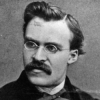
Friedrich Nietzsche
Friedrich Wilhelm Nietzschewas a German philosopher, cultural critic, poet and Latin and Greek scholar whose work has exerted a profound influence on Western philosophy and modern intellectual history. He began his career as a classical philologist before turning to philosophy. He became the youngest ever to hold the Chair of Classical Philology at the University of Basel in 1869, at the age of 24. Nietzsche resigned in 1879 due to health problems that plagued him most of his life, and...
NationalityGerman
ProfessionPhilosopher
Date of Birth15 October 1844
CityRocken, Germany
CountryGermany
Wherever progress is to ensue, deviating natures are of greatest importance.
The greatest progress that the human race has made lies in learning how to make correct inferences.
Whereas the man of action binds his life to reason and its concepts so that he will not be swept away and lost, the scientific investigator builds his hut right next to the tower of science so that he will be able to work on it and to find shelter for himself beneath those bulwarks which presently exist.
The magnitude of a progress is gauged by the greatness of the sacrifice that it requires.
Madness is rare in individuals - but in groups, parties, nations, and ages it is the rule.
Sing me a new song; the world is transfigured; all the Heavens are rejoicing.
Germany is a great nation only because its people have so much Polish blood in their veins.
We should consider every day lost on which we have not danced at least once. And we should call every truth false which was not accompanied by at least one laugh.
Not when truth is dirty, but when it is shallow, does the enlightened man dislike to wade into its waters.
I am a pure-blooded Polish nobleman without a single drop of bad blood - certainly not German blood.
In individuals, insanity is rare; but in groups, parties, nations and epochs, it is the rule.
When man does not have firm, calm lines on the horizon of his life- mountain and forest lines, as it were- then a man's innermost will becomes agitated, preoccupied, and wistful.
However modest one may be in one's demand for intellectual cleanliness, one cannot help feeling, when coming into contact with the New Testament, a kind of inexpressible discomfiture: for the unchecked impudence with which the least qualified want to raise their voice on the greatest problems, and even claim to be judges of things, surpasses all measure. The shameless levity with which the most intractable problems (life, world, God, purpose of life) are spoken of, as if they were not problems at all but simply things that these little bigots KNEW!
He who does not lie does not know what truth is.