Friedrich Nietzsche
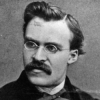
Friedrich Nietzsche
Friedrich Wilhelm Nietzschewas a German philosopher, cultural critic, poet and Latin and Greek scholar whose work has exerted a profound influence on Western philosophy and modern intellectual history. He began his career as a classical philologist before turning to philosophy. He became the youngest ever to hold the Chair of Classical Philology at the University of Basel in 1869, at the age of 24. Nietzsche resigned in 1879 due to health problems that plagued him most of his life, and...
NationalityGerman
ProfessionPhilosopher
Date of Birth15 October 1844
CityRocken, Germany
CountryGermany
All credibility, all good conscience, all evidence of truth come only from the senses.
Socrates condemned art because he preferred philosophy and only after much internal struggle did Plato accept this judgment.
When I was twelve years old I thought up an odd trinity: namely, God the Father, God the Son, and God the Devil. My inference wasthat God, in contemplating himself, created the second person of the godhead; but that, in order to be able to contemplate himself, he had to contemplate, and thus to create, his opposite.--With this I began to do philosophy.
The Greeks, with their truly healthy culture, have once and for all justified philosophy simply by having engaged in it, and having engaged in it more fully than any other people.
At the very moment when someone is beginning to take philosophy seriously, the whole world believes the opposite.
In every philosophical school, three thinkers succeed one another in the following way: the first produces out of himself the sapand seed, the second draws it out into threads and spins a synthetic web, and the third waits in this web for the sacrificial victims that are caught in it--and tries to live off philosophy.
[Philosophers] are not honest enough in their work, although they make a lot of virtuous noise when the problem of truthfulness is touched even remotely. They all pose as if they had discovered and reached their real opinions through the self-development of a cold, pure, divinely unconcerned dialectic...; while at bottom it is an assumption, a hunch, indeed a kind of "inspiration" most often a desire of the heart that has been filtered and made abstract that they defend with reasons they have sought after the fact.
More and more it seems to me that the philosopher, being of necessity a man of tomorrow and the day after tomorrow, has always found himself, and had to find himself, in contradiction to his today: his enemy was ever the ideal of today. So far all these extraordinary furtherers of men whom one calls philosophers, though they themselves have rarely felt like friends of wisdom but rather like disagreeable fools and dangerous question marks, have found their task, their hard, unwanted, inescapable task, but eventually also the greatness of their task, in being the bad conscience of their time.
Socrates ... is the first philosopher of life [Lebensphilosoph], ... Thinking serves life, while among all previous philosophers life had served thought and knowledge. ... Thus Socratic philosophy is absolutely practical: it is hostile to all knowledge unconnected to ethical implications.
Socrates.- If all goes well, the time will come when one will take up the memorabilia of Socrates rather than the Bible as a guide to morals and reason... The pathways of the most various philosophical modes of life lead back to him... Socrates excels the founder of Christianity in being able to be serious cheerfully and in possessing that wisdom full of roguishness that constitutes the finest state of the human soul. And he also possessed the finer intellect.
Even today many educated people think that the victory of Christianity over Greek philosophy is a proof of the superior truth of the former - although in this case it was only the coarser and more violent that conquered the more spiritual and delicate. So far as superior truth is concerned, it is enough to observe that the awakening sciences have allied themselves point by point with the philosophy of Epicurus, but point by point rejected Christianity.
Knapsack of the Metaphysicians.- Those who boast so mightily of the scientificality of their metaphysics should receive no answer; it is enough to pluck at the bundle which, with a certain degree of embarrassment, they keep concealed behind their back; if one succeeds in opening it, the products of that scientificality come to light, attended by their blushes: a dear little Lord God, a nice little immortality, perhaps a certain quantity of spiritualism, and in any event a whole tangled heap of 'wretched poor sinner' and Pharisee arrogance.
But in the end one also has to understand that the needs that religion has satisfied and philosophy is now supposed to satisfy are not immutable; they can be weakened and exterminated. Consider, for example, that Christian distress of mind that comes from sighing over ones inner depravity and care for ones salvation - all concepts originating in nothing but errors of reason and deserving, not satisfaction, but obliteration.
A belief, however necessary it may be for the preservation of a species, has nothing to do with truth. The falseness of a judgment is not for us necessarily an objection to a judgment. The question is to what extent it is life-promoting, life-preserving, species preserving, perhaps even species cultivating. To recognize untruth as a condition of life--that certainly means resisting accustomed value feelings in a dangerous way; and a philosophy that risks this would by that token alone place itself beyond good and evil.