Friedrich Nietzsche
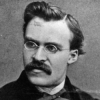
Friedrich Nietzsche
Friedrich Wilhelm Nietzschewas a German philosopher, cultural critic, poet and Latin and Greek scholar whose work has exerted a profound influence on Western philosophy and modern intellectual history. He began his career as a classical philologist before turning to philosophy. He became the youngest ever to hold the Chair of Classical Philology at the University of Basel in 1869, at the age of 24. Nietzsche resigned in 1879 due to health problems that plagued him most of his life, and...
NationalityGerman
ProfessionPhilosopher
Date of Birth15 October 1844
CityRocken, Germany
CountryGermany
With regard to philosophical metaphysics, I always see increasing numbers who have attained to the negative goal, but as yet few who climb a few rungs backwards; one ought to look out, perhaps, over the last steps of the ladder, but not try to stand upon them.
Can an ass be tragic?--To perish under a burden that one can neither bear nor cast off? The case of the philosopher.
This is the fundamental idea of culture, insofar as it sets but one task for each of us: to further the production of the philosopher, of the artist, and of the saint within us and outside us, and thereby to work at the consummation of nature.
The Greeks, with their truly healthy culture, have once and for all justified philosophy simply by having engaged in it, and having engaged in it more fully than any other people.
At the very moment when someone is beginning to take philosophy seriously, the whole world believes the opposite.
In every philosophical school, three thinkers succeed one another in the following way: the first produces out of himself the sapand seed, the second draws it out into threads and spins a synthetic web, and the third waits in this web for the sacrificial victims that are caught in it--and tries to live off philosophy.
What the philosopher is seeking is not truth, but rather the metamorphosis of the world into man.
The philosopher caught in the nets of language.
A philosophical mythology lies concealed in language, which breaks out again at every moment, no matter how cautious we may be.
It was modesty that invented the word "philosopher" in Greece and left the magnificent overweening presumption in calling oneselfwise to the actors of the spirit--the modesty of such monsters of pride and sovereignty as Pythagoras, as Plato.
What verse is for the poet, dialectical thinking is for the philosopher. He grasps for it in order to get hold of his own enchantment, in order to perpetuate it.
Socrates.- If all goes well, the time will come when one will take up the memorabilia of Socrates rather than the Bible as a guide to morals and reason... The pathways of the most various philosophical modes of life lead back to him... Socrates excels the founder of Christianity in being able to be serious cheerfully and in possessing that wisdom full of roguishness that constitutes the finest state of the human soul. And he also possessed the finer intellect.
The irrationality of a thing is no argument against its existence, rather a condition of it.
The advantage of a bad memory is that one enjoys several times the same good things for the first time.