Friedrich Nietzsche
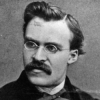
Friedrich Nietzsche
Friedrich Wilhelm Nietzschewas a German philosopher, cultural critic, poet and Latin and Greek scholar whose work has exerted a profound influence on Western philosophy and modern intellectual history. He began his career as a classical philologist before turning to philosophy. He became the youngest ever to hold the Chair of Classical Philology at the University of Basel in 1869, at the age of 24. Nietzsche resigned in 1879 due to health problems that plagued him most of his life, and...
NationalityGerman
ProfessionPhilosopher
Date of Birth15 October 1844
CityRocken, Germany
CountryGermany
You know these things as thoughts, but your thoughts are not your experiences, they are an echo and after-effect of your experiences: as when your room trembles whe na carriage goes past. I however am sitting in the carriage, and often I am the carriage itself. Ina man who thinks like this, the dichotomy between thinking and feeling, intellect and passion, has really disappeared. He feels his thoughts. He can fall in love with an idea. An idea can make him ill.
The overman...Who has organized the chaos of his passions, given style to his character, and become creative. Aware of life's terrors, he affirms life without resentment.
love as a passion—it is our European specialty—must absolutely be of noble origin; as is well known, its invention is due to the Provencal poet-cavaliers, those brilliant, ingenious men of the "gai saber," to whom Europe owes so much, and almost owes itself.
You implanted your highest goal into the heart of those passions: then they became your virtues and joys.
That whatever a man says, promises, or resolves in passion he must stick to later on when he is cold and sober--this demand is among the heaviest burdens that weigh on humankind.
Just as bones, tissues, intestines, and blood vessels are enclosed in a skin that makes it possible to bear the sight of a human being, so the agitations and passions of the soul are wrapped up in vanity: it is the soul's skin.
In a seriously intended intellectual emancipation a person's mute passions and cravings also hope to find their advantage.
The grand style follows suit with all great passion. It disdains to please, it forgets to persuade. It commands. It wills.
The child as a monument to the passion of two people; the will to oneness in two.
By means of music the very passions, enjoy themselves.
All human life is sunk deep in untruth; the individual cannot pull it out of this well without growing profoundly annoyed with his entire past, without finding his present motives (like honor) senseless, and without opposing scorn and disdain to the passions that urge one on to the future and to the happiness in it.
The same passions in man and woman nonetheless differ in tempo; hence man and woman do not cease misunderstanding one another.
In music the passions enjoy themselves.
Is life not a thousand times too short for us to bore ourselves?