Friedrich Nietzsche
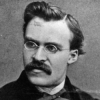
Friedrich Nietzsche
Friedrich Wilhelm Nietzschewas a German philosopher, cultural critic, poet and Latin and Greek scholar whose work has exerted a profound influence on Western philosophy and modern intellectual history. He began his career as a classical philologist before turning to philosophy. He became the youngest ever to hold the Chair of Classical Philology at the University of Basel in 1869, at the age of 24. Nietzsche resigned in 1879 due to health problems that plagued him most of his life, and...
NationalityGerman
ProfessionPhilosopher
Date of Birth15 October 1844
CityRocken, Germany
CountryGermany
Whoever has provoked men to rage against him has always gained a party in his favor, too.
Heraclitus was an opponent of all democratic parties.
The beating of drums, which delights young writers who serve a party, sounds to him who does not belong to the party line like a rattling of chains, and excites sympathy rather than admiration.
When anyone apologizes to us he has to do it very expertly: otherwise we might easily come to see ourselves as the guilty party and experience unpleasant feelings.
All parties attempt to represent important things that have developed outside themselves as unimportant, and where they fail in this they assail those things all the more bitterly the more admirable they are.
He who thinks a great deal is not suited to be a party man: he thinks his way through the party and out the other side too soon.
The newspaper reader says: this party will ruin itself if it makes errors like this. My higher politics says: a party which makes errors like this is already finished -- it is no longer secure in its instincts.
In every party there is one person who, through his dotingly credulous enunciation of party principles, incites the other members to defection.
Insanity in individuals is something rare - but in groups, parties, nations and epochs, it is the rule.
The most dangerous follower is the one whose defection would destroy the whole party: hence, the best follower.
There are men who desire power simply for the sake of the happiness it will bring; these belong chiefly to political parties.
For both parties in a controversy, the most disagreeable way of retaliating is to be vexed and silent; for the aggressor usually regards the silence as a sign of contempt.
When man does not have firm, calm lines on the horizon of his life- mountain and forest lines, as it were- then a man's innermost will becomes agitated, preoccupied, and wistful.
However modest one may be in one's demand for intellectual cleanliness, one cannot help feeling, when coming into contact with the New Testament, a kind of inexpressible discomfiture: for the unchecked impudence with which the least qualified want to raise their voice on the greatest problems, and even claim to be judges of things, surpasses all measure. The shameless levity with which the most intractable problems (life, world, God, purpose of life) are spoken of, as if they were not problems at all but simply things that these little bigots KNEW!