Friedrich Nietzsche
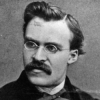
Friedrich Nietzsche
Friedrich Wilhelm Nietzschewas a German philosopher, cultural critic, poet and Latin and Greek scholar whose work has exerted a profound influence on Western philosophy and modern intellectual history. He began his career as a classical philologist before turning to philosophy. He became the youngest ever to hold the Chair of Classical Philology at the University of Basel in 1869, at the age of 24. Nietzsche resigned in 1879 due to health problems that plagued him most of his life, and...
NationalityGerman
ProfessionPhilosopher
Date of Birth15 October 1844
CityRocken, Germany
CountryGermany
As soon as a religion comes to dominate it has as its opponents all those who would have been its first disciples.
Heraclitus was an opponent of all democratic parties.
Sometimes we remain true to a cause simply because its opponents are unfailingly tasteless.
The task is not to overcome opponents in general but only those opponents against whom one has to summon all one's strength, one's skill and one's swordsmanship-in fact to master opponents who are one's equals.
We do not place especial value on the possession of a virtue until we notice its total absence in our opponent.
Every society has a tendency to reduce it's opponents to caricatures.
A book full of brilliance imparts some of it even to its opponents.
A good seat on a horse steals away your opponent's courage and your onlooker's heart-what reason is there to attack? Sit like one who has conquered?
A book is made better by good readers and clearer by good opponents.
To be the equal of one's opponent-this is the first condition of an honourable duel.
The strongest knowledge (that of the total freedom of the human will) is nonetheless the poorest in successes: for it always has the strongest opponent, human vanity.
When man does not have firm, calm lines on the horizon of his life- mountain and forest lines, as it were- then a man's innermost will becomes agitated, preoccupied, and wistful.
However modest one may be in one's demand for intellectual cleanliness, one cannot help feeling, when coming into contact with the New Testament, a kind of inexpressible discomfiture: for the unchecked impudence with which the least qualified want to raise their voice on the greatest problems, and even claim to be judges of things, surpasses all measure. The shameless levity with which the most intractable problems (life, world, God, purpose of life) are spoken of, as if they were not problems at all but simply things that these little bigots KNEW!
He who does not lie does not know what truth is.