Friedrich Nietzsche
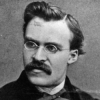
Friedrich Nietzsche
Friedrich Wilhelm Nietzschewas a German philosopher, cultural critic, poet and Latin and Greek scholar whose work has exerted a profound influence on Western philosophy and modern intellectual history. He began his career as a classical philologist before turning to philosophy. He became the youngest ever to hold the Chair of Classical Philology at the University of Basel in 1869, at the age of 24. Nietzsche resigned in 1879 due to health problems that plagued him most of his life, and...
NationalityGerman
ProfessionPhilosopher
Date of Birth15 October 1844
CityRocken, Germany
CountryGermany
God is dead, but considering the state the species man is in, there will perhaps be caves, for ages yet, in which his shadow will be shown.
There is in general good reason to suppose that in several respects the gods could all benefit from instruction by us human beings. We humans are - more humane.
Once spirit was God, then it became man, and now it is even becoming mob.
The love of one sole being is a barbarism; for it will be employed to the detriment of all the rest. So too the love of God.
Many things about man are not very godly: whenever a person excretes feces, how can he be a god then? But it is even worse regarding the other feces we call sin: man still surely wants to retain this, and not excrete it. Now however, I must believe it: a person can be God and still excrete feces. Thus I teach you, excrete your feces and become gods.
Precisely this is godliness--that there are gods, but no God.
One should only question gods where none but gods can reply.
Everything good is the transmutation of something evil: every god has a devil for a father.
When gods die, they always die many sorts of death.
When I was twelve years old I thought up an odd trinity: namely, God the Father, God the Son, and God the Devil. My inference wasthat God, in contemplating himself, created the second person of the godhead; but that, in order to be able to contemplate himself, he had to contemplate, and thus to create, his opposite.--With this I began to do philosophy.
Around the hero everything turns into a tragedy, around the demigod, a satyr-play, and around God--what? perhaps a "world"?
I teach you the Overman. Man is something which shall be surpassed.
There did he sit shrivelled in his chimney corner, fretting on account of his weak legs, world weary, will weary, and one day he suffocated through his excessive pity.
A nation that still believes in itself holds fast to its own god.