Friedrich Nietzsche
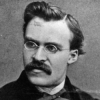
Friedrich Nietzsche
Friedrich Wilhelm Nietzschewas a German philosopher, cultural critic, poet and Latin and Greek scholar whose work has exerted a profound influence on Western philosophy and modern intellectual history. He began his career as a classical philologist before turning to philosophy. He became the youngest ever to hold the Chair of Classical Philology at the University of Basel in 1869, at the age of 24. Nietzsche resigned in 1879 due to health problems that plagued him most of his life, and...
NationalityGerman
ProfessionPhilosopher
Date of Birth15 October 1844
CityRocken, Germany
CountryGermany
Light for some time to come will have to be called darkness.
You say, it's dark. And in truth, I did place a cloud before your sun. But do you not see how the edges of the cloud are already glowing and turning light.
How can a man know himself? He is a thing dark and veiled; and if the hare has seven skins, man can slough off seventy times seven and still not be able to say: "this is really you, this is no longer outer shell.
In the dark, time feels different than when it is light.
I want to teach men the sense of their existence, which is the Superman, the lightning out of the dark cloud man.
Being human is a complicated gig. So give that ol' dark night of the soul a hug. Howl the eternal yes!
I am a forest, and a night of dark trees: but he who is not afraid of my darkness, will find banks full of roses under my cypresses.
But it is the same with man as with the tree. The more he seeks to rise into the height and light, the more vigorously do his roots struggle earthword, downword, into the dark, the deep - into evil.
I was in darkness, but I took three steps and found myself in paradise. The first step was a good thought, the second, a good word; and the third, a good deed.
I love all who are like heavy drops falling one by one out of the dark cloud that lowereth over man: they herald the coming of the lightning, and succumb as heralds.
We must understand how to hide in darkness in order to escape the gnat-swarms of utterly annoying admirers.
When man does not have firm, calm lines on the horizon of his life- mountain and forest lines, as it were- then a man's innermost will becomes agitated, preoccupied, and wistful.
However modest one may be in one's demand for intellectual cleanliness, one cannot help feeling, when coming into contact with the New Testament, a kind of inexpressible discomfiture: for the unchecked impudence with which the least qualified want to raise their voice on the greatest problems, and even claim to be judges of things, surpasses all measure. The shameless levity with which the most intractable problems (life, world, God, purpose of life) are spoken of, as if they were not problems at all but simply things that these little bigots KNEW!
He who does not lie does not know what truth is.