Friedrich Nietzsche
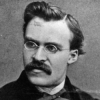
Friedrich Nietzsche
Friedrich Wilhelm Nietzschewas a German philosopher, cultural critic, poet and Latin and Greek scholar whose work has exerted a profound influence on Western philosophy and modern intellectual history. He began his career as a classical philologist before turning to philosophy. He became the youngest ever to hold the Chair of Classical Philology at the University of Basel in 1869, at the age of 24. Nietzsche resigned in 1879 due to health problems that plagued him most of his life, and...
NationalityGerman
ProfessionPhilosopher
Date of Birth15 October 1844
CityRocken, Germany
CountryGermany
You say 'I' and you are proud of this word. But greater than this- although you will not believe in it - is your body and its great intelligence, which does not say 'I' but performs 'I'.
I want to speak to the despisers of the body. I would not have them learn and teach differently, but merely say farewell to their own bodies-- and thus become silent.
There is more wisdom in your body than in your best wisdom. And who then knows why your body needs precisely your best wisdom?
Every living body continuously eliminates feces, it rejects what is not serviceable to the assimilating organism: what man despises, what arouses his disgust, what he calls evil, are excrements.
When one thinks profusely and cleverly, not only his face but his body too takes on a clever appearance.
The body is a big sagacity, a plurality with one sense, a war and a peace, a flock and a shepherd.
But like infection is the petty thought: it creeps and hides, and wants to be nowhere--until the whole body is decayed and withered by the petty infection... Thus spoke Zarathustra.
Your soul will be dead even before your body: fear nothing further.
Body am I entirely, and nothing else; and soul is only a word for something about the body.
In true love it is the soul that envelops the body.
Our body is simply a social structure made of many souls.
We operate with nothing but things which do not exist, with lines, planes, bodies, atoms, divisible time, divisible space - how should explanation even be possible when we first make everything into an image, into our own image!
When man does not have firm, calm lines on the horizon of his life- mountain and forest lines, as it were- then a man's innermost will becomes agitated, preoccupied, and wistful.
However modest one may be in one's demand for intellectual cleanliness, one cannot help feeling, when coming into contact with the New Testament, a kind of inexpressible discomfiture: for the unchecked impudence with which the least qualified want to raise their voice on the greatest problems, and even claim to be judges of things, surpasses all measure. The shameless levity with which the most intractable problems (life, world, God, purpose of life) are spoken of, as if they were not problems at all but simply things that these little bigots KNEW!