Friedrich Nietzsche
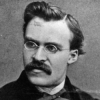
Friedrich Nietzsche
Friedrich Wilhelm Nietzschewas a German philosopher, cultural critic, poet and Latin and Greek scholar whose work has exerted a profound influence on Western philosophy and modern intellectual history. He began his career as a classical philologist before turning to philosophy. He became the youngest ever to hold the Chair of Classical Philology at the University of Basel in 1869, at the age of 24. Nietzsche resigned in 1879 due to health problems that plagued him most of his life, and...
NationalityGerman
ProfessionPhilosopher
Date of Birth15 October 1844
CityRocken, Germany
CountryGermany
Assuming that rapture is nature's play with man, the Dionysian artist's creative activity is the play with rapture.
As refined fare serves a hungry man as well as and no better than coarser food, the more pretentious artist will not dream of inviting the hungry man to his meal.
We grow hostile to many an artist or writer, not because we finally come to see he has deceived us, but because he thought no subtler means were required to ensnare us.
This is the fundamental idea of culture, insofar as it sets but one task for each of us: to further the production of the philosopher, of the artist, and of the saint within us and outside us, and thereby to work at the consummation of nature.
Whenever the truth is uncovered, the artist will always cling with rapt gaze to what still remains covering even after such uncovering; but the theoretical man enjoys and finds satisfaction in the discarded covering and finds the highest object of his pleasure in the process of an ever happy uncovering that succeeds through his own efforts.
The advocates of a criminal are seldom artists enough to turn the beautiful terribleness of the deed to the advantage of the doer.
Beauty is for the artist something outside all orders of rank, because in beauty opposites are tamed; the highest sign of power, namely power over opposites; moreover, without tension: - that violence is no longer needed: that everything follows, obeys, so easily and so pleasantly - that is what delights the artist's WILL TO POWER.
In intercourse with scholars and artists one readily makes mistakes of opposite kinds: in a remarkable scholar one not infrequently finds a mediocre man; and often, even in a mediocre artist, one finds a very remarkable man.
No artist will tolerate the world for one second as it is.
Artists may here have a more subtle scent: they know only too well that it is precisely when they cease to act 'voluntarily' and do everything of necessity that their feeling of freedom, subtlety, fullness of power, creative placing, disposing, shaping reaches its height - in short, that necessity and 'freedom of will' are then one in them.
All great artists and thinkers are great workers.
Since men do not really respect anything unless it was established long ago and has developed slowly over time, those who want tokeep on living after their death must take worry not only about their future generations but even more about their past: that is why tyrants of all kinds (including tyrannical artists and politicians) like to do violence to history, so that it will appear as a preparation and stepladder to themselves.
An artist chooses his subjects: that is the way he praises.
Success has always been the greatest liar - and the "work" itself is a success; the great statesman, the conqueror, the discoverer is disguised by his creations, often beyond recognition; the "work," whether of the artist or the philosopher, invents the man who has created it, who is supposed to have create it; "great men," as they are venerated, are subsequent pieces of wretched minor fiction