Ernest Hemingway
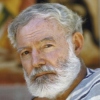
Ernest Hemingway
Ernest Miller Hemingwaywas an American novelist, short story writer, and journalist. His economical and understated style had a strong influence on 20th-century fiction, while his life of adventure and his public image influenced later generations. Hemingway produced most of his work between the mid-1920s and the mid-1950s, and won the Nobel Prize in Literature in 1954. He published seven novels, six short story collections, and two non-fiction works. Additional works, including three novels, four short story collections, and three non-fiction...
NationalityAmerican
ProfessionNovelist
Date of Birth21 July 1899
CityOak Park, IL
CountryUnited States of America
I would take anything I love and throw it off the highest cliff you ever saw and not wait to hear it bounce.
I've seen you, beauty, and you belong to me now, whoever you are waiting for and if I never see you again, I thought. You belong to me and all Paris belongs to me and I belong to this notebook and this pencil.
A writer can be compared to a well. There are as many kinds of wells as there are writers. The important thing is to have good water in the well, and it is better to take a regular amount out than to pump the well dry and wait for it to refill.
We wait always for something that does not come.
Before you react, think. Before you spend, earn. Before you criticize, wait. Before you quit, try.
You expected to be sad in the fall. Part of you dies each year when the leaves fell from the trees and their branches were bare against the wind and the cold, wintry light. But you knew there would always be the spring, as you knew the river would flow again after it was frozen. When the cold rains kept on and killed the spring, it was as though a young person had died for no reason.
I wake up in the morning and my mind starts making sentences, and I have to get rid of them fast - talk them or write them down.
I love to go to the zoo. But not on Sunday. I don't like to see the people making fun of the animals, when it should be the other way around.
On the 'Star,' you were forced to learn to write a simple declarative sentence. This is useful to anyone. Newspaper work will not harm a young writer and could help him if he gets out of it in time.
After you finish a book, you know, you're dead. But no one knows you're dead. All they see is the irresponsibility that comes in after the terrible responsibility of writing.
A writer of fiction is really... a congenital liar who invents from his own knowledge or that of other men.
'For Whom the Bell Tolls' was a problem which I carried on each day. I knew what was going to happen in principle. But I invented what happened each day I wrote.
You see, I am trying in all my stories to get the feeling of the actual life across - not to just depict life - or criticize it - but to actually make it alive. So that when you have read something by me, you actually experience the thing. You can't do this without putting in the bad and the ugly as well as what is beautiful.
Certainly it is valuable to a trained writer to crash in an aircraft which burns. He learns several important things very quickly. Whether they will be of use to him is conditioned by survival. Survival, with honor, that outmoded and all-important word, is as difficult as ever and as all-important to a writer.