Carrie Mae Weems
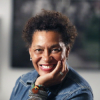
Carrie Mae Weems
Carrie Mae Weemsis an American artist who works with text, fabric, audio, digital images, and installation video but is best known for her work in the field of photography. Her award-winning photographs, films, and videos have been displayed in over 50 exhibitions in the United States and abroad and focus on serious issues that face African Americans today, such as racism, gender relations, politics, and personal identity. She has said, "Let me say that my primary concern in art, as...
NationalityAmerican
ProfessionPhotographer
CountryUnited States of America
It's fair to say that black folks operate under a cloud of invisibility - this too is part of the work, is indeed central to [my photographs]... This invisibility - this erasure out of the complex history of our life and time - is the greatest source of my longing.
It's impossible to change the social without changing the personal - you have to put your money where your mouth is. And if you're not making those challenges at home, it's unlikely you'll make them in a larger setting.
I come from a family of Mississippi sharecroppers just a few generations away from slavery, and I experienced a lot of racism growing up - you can't avoid that if you're a person of color in this country.
My father was very interested in music, and when he and his brothers were young, they had a singing group that used to open for Sam Cooke. There was always music in our house, but there wasn't much art around.
In terms of digital photography, I continue to print and use film for the most part. I still shoot with film, 21/4 film specifically, and I love it. I love it because I know what it does, how it really responds to light.
I think that still, for the most part, even in 2010, the vast majority of museum shows and gallery shows and gallerists are pretty much dominated by men. So having a sense of what women are up to, for me, frankly, is very, very important.
I emerged in that incredible moment in the 1980s when all kinds of social questions about subjectivity and objectivity, about who was making, who was looking.
I didnt know photography would take me to the places that it has taken me
I don't like directing a lot of people. So trying to keep things really simple and elegant is my preferred way of working.
Suddenly this camera, this thing, allowed me to move around the world in a certain kind of way, with a certain kind of purpose. (On receiving a camera for her twenty-first birthday)
I really like the structure of my body. It moves well, it looks good, it photographs well, it understands gesture and nuance.
Sometimes my work needs to be photographic, sometimes it needs words, sometimes it needs to have a relationship with music, sometimes it needs all three and become a video projection.
I got my first camera when I was 21 - my boyfriend gave it to me for my birthday - but at that point politics was my life, and I viewed the camera as a tool for expressing my political beliefs rather than as an art medium.
It's very important for me to really use this body as a barometer of a certain kind of knowledge--to take the personal risk of exposing my own body in a certain kind of way. I can't ask anybody else to do something that I don't do first myself.