Blaise Pascal
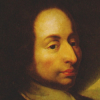
Blaise Pascal
Blaise Pascalwas a French mathematician, physicist, inventor, writer and Christian philosopher. He was a child prodigy who was educated by his father, a tax collector in Rouen. Pascal's earliest work was in the natural and applied sciences where he made important contributions to the study of fluids, and clarified the concepts of pressure and vacuum by generalising the work of Evangelista Torricelli. Pascal also wrote in defence of the scientific method...
NationalityFrench
ProfessionPhilosopher
Date of Birth19 June 1623
CityClermont-Ferrand, France
CountryFrance
Seeing too much to deny and too little to be sure, I am in a state to be pitied.
Too much and too little wine. Give him none, he cannot find truth; give him too much, the same.
Man's sensitivity to the little things and insensitivity to the greatest are the signs of a strange disorder.
Little things console us because little things afflict us.
A little thing comforts us because a little thing afflicts us.
Thinking too little about things or thinking too much both make us obstinate and fanatical.
Since we cannot know all that there is to be known about anything, we ought to know a little about everything.
Do little things as if they were great, because of the majesty of the Lord Jesus Christ who dwells in thee.
Lord, help me to do great things as though they were little, since I do them with your power; And little things as though they were great, since I do them in your name!
The weather and my mood have little connection. I have my foggy and my fine days within me; my prosperity or misfortune has little to do with the matter.
This religion taught to her children what men have only been able to discover by their greatest knowledge.
What is man in nature? Nothing in relation to the infinite, all in relation to nothing, a mean between nothing and everything
Two kinds of persons know Him: those who have a humble heart, and who love lowliness, whatever kind of intellect they may have, high or low; and those who have sufficient understanding to see the truth, whatever opposition they may have to it.
Faith certainly tells us what the senses do not, but not the contrary of what they see; it is above, not against them.