Blaise Pascal
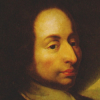
Blaise Pascal
Blaise Pascalwas a French mathematician, physicist, inventor, writer and Christian philosopher. He was a child prodigy who was educated by his father, a tax collector in Rouen. Pascal's earliest work was in the natural and applied sciences where he made important contributions to the study of fluids, and clarified the concepts of pressure and vacuum by generalising the work of Evangelista Torricelli. Pascal also wrote in defence of the scientific method...
NationalityFrench
ProfessionPhilosopher
Date of Birth19 June 1623
CityClermont-Ferrand, France
CountryFrance
God instituted prayer to communicate to creatures the dignity of causality.
All of our dignity consists in thought. Let us endeavor then to think well; this is the principle of morality.
Thought makes the whole dignity of man; therefore endeavor to think well, that is the only morality.
All our dignity lies in our thoughts.
Meanings receive their dignity from words instead of giving it to them.
All the dignity of man consists in thought. Thought is therefore by its nature a wonderful and incomparable thing. It must have strange defects to be contemptible. But it has such, so that nothing is more ridiculous. How great it is in its nature! How vile it is in its defects! But what is this thought? How foolish it is!
This religion taught to her children what men have only been able to discover by their greatest knowledge.
What is man in nature? Nothing in relation to the infinite, all in relation to nothing, a mean between nothing and everything
Two kinds of persons know Him: those who have a humble heart, and who love lowliness, whatever kind of intellect they may have, high or low; and those who have sufficient understanding to see the truth, whatever opposition they may have to it.
Faith certainly tells us what the senses do not, but not the contrary of what they see; it is above, not against them.
It is the fight alone that pleases us, not the victory.
If all men knew what others say of them, there would not be four friends in the world.
We know the truth, not only by the reason, but also by the heart.
I have discovered that all human evil comes from this, man's being unable to sit still in a room.