Bill Gates
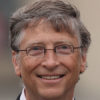
Bill Gates
William Henry "Bill" Gates IIIis an American business magnate, entrepreneur, philanthropist, investor, and programmer. In 1975, Gates and Paul Allen co-founded Microsoft, which became the world's largest PC software company. During his career at Microsoft, Gates held the positions of chairman, CEO and chief software architect, and was the largest individual shareholder until May 2014. Gates has authored and co-authored several books...
NationalityAmerican
ProfessionEntrepreneur
Date of Birth28 October 1955
CitySeattle, WA
CountryUnited States of America
My dream is that every child has enough food to eat, good medical care, and the chance to go to school and even attend college.
Making sure all our students get a great education, find a career that's fulfilling and rewarding, and have a chance to live out their dreams ... wouldn't just make us a more successful country - it would also make us a more fair and just one.
We're responsible for the creation of the PC industry. The whole idea of compatible machines and lots of software, that's something we brought to computing. And so it's a responsibility for us to make sure that things like security don't get in the way of that dream.
The nuclear approach I'm involved in is called a traveling-wave reactor, which uses waste uranium for fuel. There's a lot of things that have to go right for that dream to come true - many decades of building demo plants, proving the economics are right. But if it does, you could have cheaper energy with no CO2 emissions.
When Paul Allen and I started Microsoft over 30 years ago, we had big dreams about software. We had dreams about the impact it could have.
My experience of malaria was just taking anti-malarials, which give you strange dreams, because I don't want to get malaria.
The dreams of the past - whether it was public TV being rolled into the classroom to teach Spanish, or the film projectors or the videotapes or the computer-aided instruction drill systems - the hopes have been dashed in terms of technology having some big impact. The foundation, I think can play a unique role there. Now, our money is more to the teacher-effectiveness thing, and technology is No. 2, but I'll probably spend more money on the technology things.
We are not even close to finishing the basic dream of what the PC can be.
I really had a lot of dreams when I was a kid, and I think a great deal of that grew out of the fact that I had a chance to read a lot.
It is certainly a dream come true in that we set a computer on every desk in every home and have the level of sales and profitability and employees we have today,
I never expected Microsoft to be so successful, ... We're not ashamed that we've taken the low-price, high-volume approach here, which is different than the competitors, who are trying to get a leg-up from the government.
In five years the cost of computation will really be effectively decreased. We'll be able to put on somebody's desk, for an incredibly low cost, a processor with far more capability than you could ever take advantage of.
In India it will be a decade before we get that level.
In most companies, you don't get too much mail where people are saying, 'Hey, we lost this account.' But that's what you really need to know about, because it might change what you're doing. You need to know about competitive activity. You need to kn