Benoit Mandelbrot
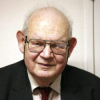
Benoit Mandelbrot
Benoit B. Mandelbrot was a Polish-born, French and American mathematician with broad interests in the practical sciences, especially regarding what he labeled as "the art of roughness" of physical phenomena and "the uncontrolled element in life." He referred to himself as a "fractalist". He is recognized for his contribution to the field of fractal geometry, which included coining the word "fractal'", as well as developing a theory of "roughness and self-similarity" in nature...
NationalityFrench
ProfessionMathematician
Date of Birth20 November 1924
CountryFrance
When people ask me what's my field? I say, on one hand, a fractalist. Perhaps the only one, the only full-time one.
I was asking questions which nobody else had asked before, because nobody else had actually looked at certain structures. Therefore, as I will tell, the advent of the computer, not as a computer but as a drawing machine, was for me a major event in my life. That's why I was motivated to participate in the birth of computer graphics, because for me computer graphics was a way of extending my hand, extending it and being able to draw things which my hand by itself, and the hands of nobody else before, would not have been able to represent.
One of my conjectures was solved in six months, a second in five years, a third in 10. But the basic conjecture remains-the Mandelbrot Set.
Until a few years ago, the topics in my Ph.D. were unfashionable, but they are very popular today.
The techniques I developed for studying turbulence, like weather, also apply to the stock market
When the weather changes, nobody believes the laws of physics have changed. Similarly, I don't believe that when the stock market goes into terrible gyrations its rules have changed
I didn't want to become a pure mathematician, as a matter of fact, my uncle was one, so I knew what the pure mathematician was and I did not want to be a pure - I wanted to do something different.
The Mandelbrot set is the most complex mathematical object known to mankind.
If you have a hammer, use it everywhere you can, but I do not claim that everything is fractal.
I conceived, developed and applied in many areas a new geometry of nature, which finds order in chaotic shapes and processes. It grew without a name until 1975, when I coined a new word to denote it, fractal geometry, from the Latin word for irregular and broken up, fractus. Today you might say that, until fractal geometry became organized, my life had followed a fractal orbit.
In fact, I barely missed being number one in France in both schools. In particular I did very well in mathematical problems.
I don't seek power and do not run around
Asking the right questions is as important as answering them
Science would be ruined if (like sports) it were to put competition above everything else, and if it were to clarify the rules of competition by withdrawing entirely into narrowly defined specialties. The rare scholars who are nomads-by-choice are essential to the intellectual welfare of the settled disciplines.