Benjamin Franklin
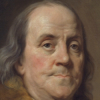
Benjamin Franklin
Benjamin Franklinwas one of the Founding Fathers of the United States. A renowned polymath, Franklin was a leading author, printer, political theorist, politician, freemason, postmaster, scientist, inventor, civic activist, statesman, and diplomat. As a scientist, he was a major figure in the American Enlightenment and the history of physics for his discoveries and theories regarding electricity. As an inventor, he is known for the lightning rod, bifocals, and the Franklin stove, among other inventions. He facilitated many civic organizations, including...
NationalityAmerican
ProfessionScientist
Date of Birth17 January 1706
CityBoston, MA
CountryUnited States of America
After crosses and losses men grow humbler and wiser.
It is a strange anomaly that men could be careful to insure their houses, their ships, their merchandise, and yet neglect to insure their lives - surely the most important of all to their families, and more subject to loss.
Eat not to dullness, drink not to elevation.
I guess I don't so much mind being old, as I mind being fat and old.
Bad gains are true losses.
In New England they once thought blackbirds useless, and mischievous to the corn. They made efforts to destroy them. The consequence was, the blackbirds were diminished; but a kind of worm, which devoured their grass, and which the blackbirds used to feed on, increased prodigiously; then, finding their loss in grass much greater than their saving in corn, they wished again for their blackbirds.
The great secret of succeeding in conversation is to admire little, to hear much; always to distrust our own reason, and sometimes that of our friends; never to pretend to wit, but to make that of others appear as much as possibly we can; to hearken to what is said and to answer to the purpose.
That it is better that 100 guilty persons should escape than that one innocent person should suffer, is a maxim that has been long and generally approved.
The nearest way to come at glory, is to do that for conscience which we do for glory.
Again, He that sells upon Credit, asks a Price for what he sells, equivalent to the Principal and Interest of his Money for the Time he is like to be kept out of it: therefore
The favor of the Great is no inheritance.
If man could have half his wishes he would double his troubles
I never saw an oft-transplanted tree, Nor yet an oft-removed family, That throve so well as those that settled be
In each religion there are essential things, and others which are only forms and fashions; as a loaf of sugar may perhaps be wrapped in brown or white or blue paper, and tied with a string of flax or wool, red or yellow; but the sugar is always the e