Barbara Kruger
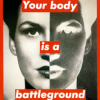
Barbara Kruger
Barbara Krugeris an American conceptual artist. Much of her work consists of black-and-white photographs overlaid with declarative captions—in white-on-red Futura Bold Oblique or Helvetica Ultra Condensed. The phrases in her works often include pronouns such as "you", "your", "I", "we", and "they", addressing cultural constructions of power, identity, and sexuality. Kruger lives and works in New York and Los Angeles...
NationalityAmerican
ProfessionConceptual Artist
Date of Birth26 January 1945
CityNewark, NJ
CountryUnited States of America
I believe that who we are, and consequently the work that we make, whether we're visual artists or writers or journalists or filmmakers, is a projection of where we were born, what's been withheld or lavished upon us, our color, our sex, our class. And everything we do in life to some degree is a reflection of that context.
I always say that I'm an artist who works with pictures and words, so I think that the different aspects of my activity, whether it's writing criticism, or doing visual work that incorporates writing, or teaching, or curating, is all of a single cloth, and I don't make any separation in terms of those practices.
One thing I learned working at magazines was that if you couldn't get people to look at a page or a cover, then you were fired. It was all about how you create arresting works, and by arresting I mean stop people, even for a nano-second.
Women's art, political art - those categorisations perpetuate a certain kind of marginality which I'm resistant to. But I absolutely define myself as a feminist.
Images are made palpable, ironed flat by technology and, in turn, dictate the seemingly real through the representative.
the art world has always been an unrelenting taste machine, but now flavors of the month have morphed into flavors of the minute. Again, all a reflection of a wider cultural condition. I mean, the art world is slow compared with the music and movie businesses.
I think architecture is one of the predominant orderings of social space. It can construct and contain our experiences. It defines our days and nights. It literally puts us in our place.
If I bring up political power, personal power, it sounds like they're my terms, and they're not.
It's hard for me to understand how working-class people support themselves.
Look, we're all saddled with things that make us better or worse. This world is a crazy place, and I've chosen to make my work about that insanity.
The so-called language of Barbara Kruger is vernacular language. Obviously, I pick through bits and pieces of it and figure out to some degree how to objectify my experience of the world, using pictures and words that construct and contain me.
The different aspects of my activity, whether it's writing criticism, or doing visual work that incorporates writing, or teaching, or curating, is all of a single cloth, and I don't make any separation in terms of those practices.
What I'm trying to do is create moments of recognition...
I remember going into galleries and seeing this thing called conceptual art, and I understand people's marginalization from what the art subculture is because if you haven't crashed the codes, and if you don't know what it is, you feel it's a conspiracy against your unintelligence. You feel it's fraud.