Aristotle
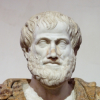
Aristotle
Aristotle was a Greek philosopher and scientist born in the city of Stagira, Chalkidice, on the northern periphery of Classical Greece. His father, Nicomachus, died when Aristotle was a child, whereafter Proxenus of Atarneus became his guardian. At eighteen, he joined Plato's Academy in Athens and remained there until the age of thirty-seven. His writings cover many subjects – including physics, biology, zoology, metaphysics, logic, ethics, aesthetics, poetry, theater, music, rhetoric, linguistics, politics and government – and constitute the first comprehensive system...
NationalityGreek
ProfessionPhilosopher
Democracy is the form of government in which the free are rulers.
For contemplation is both the highest form of activity (since the intellect is the highest thing in us, and the objects that it apprehends are the highest things that can be known), and also it is the most continuous, because we are more capable of continuous contemplation than we are of any practical activity.
Now it is evident that the form of government is best in which every man, whoever he is, can act best and live happily.
The soul is the form of the body
All human happiness and misery take the form of action.
The mathematical sciences particularly exhibit order, symmetry, and limitation; and these are the greatest forms of the beautiful.
The best friend is the man who in wishing me well wishes it for my sake.
It is the nature of desire not to be satisfied, and most men live only for the gratification of it.
Every action must be due to one or other of seven causes: chance, nature, compulsion, habit, reasoning, anger, or appetite.
Tragedy is thus a representation of an action that is worth serious attention, complete in itself and of some amplitude... by means of pity and fear bringing about the purgation of such emotions.
A true friend is one soul in two bodies.
A tragedy is the imitation of an action that is serious, and also, as having magnitude, complete in itself . . . with incidents arousing pity and terror, with which to accomplish its purgation of these emotions.
Dignity consists not in possessing honors, but in the consciousness that we deserve them.
We should behave to our friends as we would wish our friends to behave to us